Didactic model for developing variational thinking in the second cycle of primary education
Modelo Didáctico de Desarrollo del pensamiento variacional para el Segundo ciclo de la educación primaria
2 Instituto Superior de Formación Docente Salomé Ureña, Recinto Emilio Prud'Homme, República Dominicana
3 Universidad de Camagüey "Ignacio Agramonte Loynaz", Cuba
Introduction: This research arises from the persistent limitations in mathematics teaching, evidenced in national and international assessments that show low levels of performance in the mastery of essential mathematical competencies specifically related to variational thinking.
Objective: To propose a didactic model for developing variational thinking in students in the second cycle of primary education, integrating current psychological, didactic, and curricular perspectives.
Methods: Theoretical-descriptive research with systemic-structural-functional modeling. A systematic review was conducted in Scopus, Web of Science, SciELO, and Redalyc (2018-2025). From 287 documents identified, after removing duplicates and applying inclusion criteria, 89 studies were analyzed with methodological quality verified. Four analytical categories were defined: psychological foundations, didactic foundations, model components, and feasibility. Validity was assessed through expert judgment by 36 specialists (18 Dominican, 18 Cuban) using a Likert-scale instrument (α=0.87), complemented by the Mann-Whitney U test to compare subgroups.
Results: The model is based on the postulates of Vygotsky's sociocultural theory, Duval's semiotic representation theory, and contemporary research on variational thinking. It is organized into three interrelated subsystems: interpretation of variation and change, situational mathematical modeling, and inductive-deductive pattern identification, each exemplified with concrete mathematical activities. Expert evaluation confirmed the model's high relevance, coherence, and feasibility.
Conclusion: The proposal offers a solid theoretical and practical foundation for transforming mathematics teaching in primary education, strengthening the development of variational thinking through psychologically and didactically sound strategies.
Introducción: Esta investigación surge ante las limitaciones persistentes en la enseñanza de la matemática, evidenciadas en evaluaciones nacionales e internacionales que muestran bajos niveles de desempeño en el dominio de competencias matemáticas esenciales vinculadas, específicamente, con el pensamiento variacional.
Objetivo: Proponer un modelo didáctico de desarrollo del pensamiento variacional para estudiantes del segundo ciclo de la educación primaria, integrando perspectivas psicológicas, didácticas y curriculares actualizadas.
Método: Investigación teórico-descriptiva con modelación sistémico-estructural-funcional. Se realizó una revisión sistemática en Scopus, Web of Science, SciELO y Redalyc (2018-2025). De 287 documentos identificados, tras eliminar duplicados y aplicar criterios de inclusión, se analizaron 89 estudios con calidad metodológica verificada. Se definieron cuatro categorías analíticas: fundamentos psicológicos, fundamentos didácticos, componentes del modelo y factibilidad. La validez se evaluó mediante criterio de 36 expertos (18 dominicanos y 18 cubanos) con instrumento Likert (α=0,87), complementado con prueba U de Mann-Whitney para comparar subgrupos.
Resultados: El modelo se sustenta en los postulados de la teoría sociocultural de Vygotsky, la teoría de representación semiótica de Duval e investigaciones contemporáneas sobre pensamiento variacional. Se organizó en tres subsistemas interrelacionados: interpretación de variación y cambio, modelación matemática situacional e identificación inductiva-deductiva de patrones, cada uno ejemplificado con actividades matemáticas concretas. La valoración experta confirmó alta pertinencia, coherencia y factibilidad del modelo.
Conclusión: Se ofrece una base teórico-práctica sólida para transformar la enseñanza de la matemática en educación primaria, fortaleciendo el desarrollo del pensamiento variacional mediante estrategias psicológica y didácticamente fundamentadas.
Introduction
Teaching mathematics in elementary school faces complex challenges that go beyond mere procedural instruction, requiring solid psychological foundations to support meaningful learning processes. In the Dominican Republic, the results of national diagnostic assessments have consistently shown that the majority of sixth-grade students remain at elementary levels of mathematical proficiency, particularly in skills related to variational reasoning, problem-solving, and abstract thinking (Ministry of Education of the Dominican Republic [MINERD], 2018, 2022). This situation reflects profound difficulties in developing essential mathematical competencies that enable students to identify patterns, understand relationships of change and variation, and model real-world situations using mathematical tools.
Variational thinking is a fundamental pillar of early mathematical education, understood as the ability to identify changes, coordinate variables, recognize patterns, and model real-world situations (Doncel González et al., 2022). Its development during the second cycle of elementary school (4th–6th grade) is essential from both psychological and pedagogical perspectives, as it coincides with the stage of concrete operations and the emergence of formal thinking according to Piagetian theory, and with Vygotsky's zone of proximal development, where adult mediation and social interaction foster higher-order cognitive abilities (Inhelder & Piaget, 1981; Vygotsky, 1978).
The Dominican curriculum objectives for this educational level stipulate that students must develop the ability to: (a) identify patterns and regularities in numerical sequences and geometric patterns; (b) establish relationships between variables in real-world contexts; and (c) model everyday situations using mathematical representations (Báez & Gómez, 2025), which are skills inherent to variational thinking. However, in recent years, it has been demonstrated that elementary school students face significant difficulties in understanding concepts of variation and change, particularly in the transition between concrete and abstract representations (Contreras-Jaimes et al., 2020; Martínez et al., 2022).
For example, Contreras-Jaimes et al. (2020) highlight the prevalence of fifth-grade students who fail to identify growth patterns in simple numerical sequences, while Parra-Arenales et al. (2021) find that approximately one-third of fourth-grade students do not establish covariation relationships between variables in everyday contexts. These limitations have deep psychological roots, linked to insufficient processes of semiotic mediation and a lack of adequate scaffolding for the internalization of abstract concepts (Lizana Chauca & Antezana Iparraguirre, 2021).
From a psychological perspective, Vygotsky's sociocultural theory provides essential explanatory frameworks for understanding these difficulties. According to this approach, the development of abstract thinking in general—and variational thinking in particular—requires social interactions mediated by semiotic tools that enable the internalization of concepts (Vygotsky, 1978). Research in educational neuroscience confirms that the development of variational skills among 8- to 12-year-olds is directly associated with the maturation of executive functions such as cognitive flexibility, working memory, and planning (Espindola et al., 2025)—all of which can be enhanced through appropriately designed educational interventions.
The need to propose a specific instructional model for the development of variational thinking at this educational level is based on several considerations:
- Traditional models of mathematics instruction tend to prioritize algorithmic procedures over reasoning processes, overlooking the psychological foundations of meaningful learning (Doncel González et al., 2022).
- There is a disconnect between psychological foundations and prevailing instructional practices, with little attention paid to the zone of proximal development in the domain of variational concepts (Guerrero-Morales & Falk de Losada, 2023).
- Current research highlights the importance of early algebra approaches, which introduce algebraic concepts beginning in elementary school with an emphasis on relational and variational thinking (Pincheira Hauck & Alsina, 2021); however, their effective implementation remains an unresolved pedagogical challenge, as there is often a lack of instructional strategies that integrate these approaches with the psychological foundations of learning.
Specifically, these shortcomings reveal a theoretical and didactic gap: students lack systematic approaches that integrate variation, modeling, and generalization as central processes for understanding school mathematics. For this reason, the present article aims to propose a didactic model for the development of variational thinking for students in the second cycle of elementary school, integrating up-to-date psychological, didactic, and curricular perspectives.
This study is part of the research project: "The Development of Variational Thinking and Its Relationship to Mathematics Learning at the Elementary Level" (code VIR-PI-8-2024-004), funded by the Salomé Ureña Higher Institute for Teacher Training (ISFODOSU). The implementing institution is the Emilio Prud'Homme Campus in Santiago de los Caballeros, Dominican Republic.
The theoretical implications of the study lie in its potential to advance toward an integrated theory of the development of variational thinking in Dominican educational contexts. Its methodological value is reflected in the articulation of psychological, pedagogical, and epistemological constructs within a coherent and applicable framework.
Methods
Type and design of research
The research was conducted using a theoretical-descriptive approach, aimed at constructing a didactic model for the development of variational thinking. This type of study was appropriate because the purpose was to organize concepts, integrate theoretical perspectives, and propose explanatory frameworks without direct intervention on populations, as proposed by Hernández-Sampieri et al. (2014). The specific design corresponds to a theoretical modeling study with a systematic literature review, which allows for the integration of empirical evidence and diverse conceptual frameworks into a coherent proposal.
Bibliographic Information Search Strategy
A systematic search strategy was implemented in specialized databases (Scopus, Web of Science, SciELO, Redalyc) and academic repositories during the period from March 2023 to November 2025. The guidelines of the PRISMA 2020 statement were followed to ensure the transparency and rigor of the process. The inclusion criteria were as follows:
- Empirical or theoretical research on variational thinking, cognitive development in mathematics, or the teaching of early algebra in elementary education.
- Documents in Spanish, English, and Portuguese.
- Studies with samples or contextual references similar to those in the Dominican Republic.
The search was restricted to publications from 2018 to 2025 to ensure that the theoretical and empirical foundations were up to date. The search terms, combined using Boolean operators (AND, OR), included:
- "variational thinking", "pensamiento variacional", "pensamento variacional";
- "primary education", "educación primaria", "ensino fundamental";
- "early algebra", "álgebra temprana", "álgebra inicial";
- "mathematical cognitive development", "desarrollo cognitivo matemáticas", "desenvolvimento cognitivo matemático";
- "ZPD in mathematics", "ZDP matemáticas", "ZDP matemática";
- "semiotic representation in mathematics", "representación semiótica matemáticas", "representação semiótica matemática";
- "primary mathematical modeling", "modelación matemática primaria", "modelagem matemática no ensino fundamental".
The initial search identified 287 documents. After removing duplicates (n = 43), 244 titles and abstracts were reviewed, of which 155 were excluded for failing to meet the inclusion criteria. The remaining 89 documents underwent a methodological quality assessment using a checklist adapted from the Critical Appraisal Skills Programme (CASP) criteria for qualitative and quantitative studies.
The adapted checklist included six criteria: clarity of the objective, appropriateness of the design to the objective, precision in data collection/analysis, clarity in the presentation of results, relevance of the findings, and ethical considerations. Each criterion was rated as "meets," "partially meets," or "does not meet"; documents that met at least five criteria, including the first two, were considered eligible. As a result, all were deemed eligible for analysis because they met the required standards of rigor. Thus, 89 documents constituted the final sample for the study.
Study Analysis Indicators
Four categories of analysis were defined, along with their respective indicators:
- Psychological foundations of variational thinking:
- theories of cognitive development applied to mathematics;
- semiotic mediation processes;
- zone of proximal development in mathematics;
- scaffolding in variational problem-solving.
- Didactic foundations of variational thinking:
- approaches to teaching early algebra;
- theory of semiotic representation;
- mathematical modeling strategies;
- resources for developing patterns and regularities.
- Components of the didactic model:
- internal coherence;
- integration among processes;
- alignment with levels of cognitive development;
- theory-practice articulation.
- Feasibility of the model:
- contextual relevance;
- conceptual clarity;
- potential for application;
- alignment with the Dominican curriculum.
Research Methods and Ethical Considerations
The research employed theoretical methods (analysis-synthesis, induction-deduction, modeling) and empirical methods (systematic literature review, expert judgment). Rigorous standards of academic integrity were upheld through proper citation of sources, acknowledgment of authorship, and avoidance of any form of plagiarism.
Evaluation Based on Expert Judgment
A validation process was implemented using expert judgment with 36 professionals (18 from the Dominican Republic and 18 from Cuba), selected through intentional sampling according to the following criteria:
- A higher education degree in mathematics education or educational psychology.
- A minimum of 5 years of experience in primary education or research in mathematics didactics.
- Publications or academic productions in the field.
The assessment was carried out using a 20-item Likert-type instrument distributed across four dimensions (theoretical foundation, internal coherence, contextual relevance, and application potential), with a scale ranging from 1 (totally inadequate) to 5 (totally adequate). The internal consistency analysis yielded a Cronbach's α of 0.87, indicating adequate reliability.
Additionally, in order to compare the assessments between the subgroups of Dominican (n = 18) and Cuban (n = 18) experts, the use of the non-parametric Mann–Whitney U test for independent samples was planned. This test was selected due to its robustness in the absence of normality with small sample sizes. The comparison was defined a priori as part of the validation design, with the purpose of examining possible differences in the appraisal of the model according to the experts' country of origin.
Results and Discussion
Psychological and Pedagogical Foundations of Variational Thinking in Elementary Education
An analysis of the specialized literature reveals that the development of variational thinking in the second cycle of elementary education requires a conscious integration of psychological principles of cognitive development and specific pedagogical approaches. From a psychological perspective, Vygotsky's sociocultural theory provides essential explanatory frameworks for understanding how students internalize abstract concepts related to variation and change. According to Vygotsky (1978), cognitive development does not occur in isolation but is influenced by social interaction, cultural context, and language use—elements that are fundamental to the construction of complex mathematical meanings.
Research in educational psychology confirms that students aged 8–12 progressively transition from concrete thinking toward forms of gradual mathematical abstraction, a process that can be enhanced through appropriately designed educational interventions (Ibarra Rivas, 2021). In this context, the concept of the zone of proximal development (ZPD) takes on fundamental importance; it is defined as the gap between what a student can do independently and what they can achieve with the support of an adult or more capable peers (Vygotsky, 1978). Studies such as those by Espindola et al. (2025) and Martínez et al. (2022) demonstrate that educational scaffolding within the ZPD significantly facilitates the internalization of variational concepts, particularly in coordinating multiple representations of the same mathematical concept.
Duval's (1999) theory of semiotic representation registers complements these psychological perspectives by explaining the cognitive processes involved in understanding abstract mathematical objects. According to Duval, deep mathematical understanding requires coordination between at least two different systems of semiotic representation (verbal, numerical, graphical, algebraic), enabling students to access the multidimensional nature of concepts such as variables, patterns, or covariation. Recent research applied to elementary education confirms that representational flexibility is a significant predictor of success in variational thinking tasks (Guerrero-Morales & Falk de Losada, 2023; Lizana Chauca & Antezana Iparraguirre, 2021).
From the perspective of the development of specific competencies, variational thinking in elementary education manifests itself, according to Contreras-Jaimes et al. (2020) and Parra-Arenales et al. (2021), through progressive abilities to:
- Identify and describe patterns in numerical sequences and geometric patterns.
- Recognize relationships of covariation between variables in meaningful contexts.
- Represent processes of change using multiple systems of representation.
- Formulate generalizations based on the analysis of regularities.
- Model simple real-world situations using mathematical tools.
These capabilities align with the principles of the early algebra approach, which emphasizes the development of relational and variational thinking from the earliest educational levels, in contrast to traditional approaches that defer algebraic work until secondary school (Pincheira Hauck & Alsina, 2021). The integration of these psychological and pedagogical perspectives provides a solid foundation for designing educational models that address students' actual cognitive development needs.
Variational thinking is not an isolated type of thinking but rather integrates and articulates other types of mathematical thinking. The processes of interpretation, modeling, and generalization that characterize it bring together logical thinking (induction and deduction), relational thinking (establishing dependencies between variables), algebraic thinking (generalization and progressive symbolization), and geometric-spatial thinking (identification of visual patterns and shapes). This integrative nature justifies the need for a didactic model that systematically addresses the various cognitive processes involved.
Based on these theoretical assumptions and for the specific purposes of this research, variational thinking is operationally defined as the competency that enables students in the second cycle of elementary school to (1) identify and describe patterns of change and covariation in numerical, geometric, and situational contexts; (2) represent these processes using multiple systems of semiotic representation (tables, graphs, and emerging verbal and symbolic expressions); and (3) formulate generalizations based on inductive-deductive reasoning to model and predict behaviors in problem situations relevant to their life experiences. This definition integrates psychological (development of higher-order cognitive abilities), didactic (sequencing of learning processes), and epistemic (nature of the mathematical knowledge involved) components.
Didactic Modeling of the Development Process of Variational Thinking
The model consists of three subsystems that exhibit external relationships of coordination, with apparent subordination. Its didactic nature suggests an implementation sequence that begins with the subsystem "interpretation of processes of variation and change in numerical and geometric patterns structured around symbolic objects and everyday situations." This initial sequence paves the way for the subsystem "mathematical modeling of everyday situations to make the meaning of the variable, its various uses, and forms of representation more flexible." At the same time, it lays the groundwork for interaction with the subsystem "inductive-deductive identification of patterns, structures, or variational regularities for the mathematical explanation of everyday situations."
However, it is important to note that this progression is not rigid; rather, in pedagogical practice, the subsystems (processes) evolve toward relationships of coordination and dialectical integration. In this way, the model moves beyond a linear and hierarchical view, establishing itself as a dialectical and cyclical system (see figure 1).
Figure 1. Didactic model for the development of variational thinking in the second cycle of elementary education.

The model thus forms a dynamic, interdependent, and recursive system:
- The interpretation of variation drives mathematical modeling, which in turn requires and produces pattern recognition.
- Pattern recognition allows for the construction of more complex models and a broader understanding of change.
- Modeling and the identification of structures enrich and inform the interpretation of variation in new contexts.
This cycle fosters an increasingly flexible and contextualized variational way of thinking. From these systemic relationships emerges a key quality: the logical significance of processes of variation and change, which enables students to learn meaningfully, reason coherently, and consciously apply mathematical knowledge to interpret, model, and explain the world around them.
Next, through a process of theoretical abstraction, the internal structure of each of the subsystems is explained:
Subsystem: Interpretation of processes of variation and change in numerical and geometric patterns structured around symbolic objects and everyday situations
Its function is to guide students in the use of tools that enable them to identify, relate, and understand the underlying patterns in various contexts (figure 2). To this end, it is necessary to design scenarios that promote the observation and analysis of regularities, as well as the establishment of relationships between quantities and shapes, and how these change. Through these processes, students develop the ability to recognize relationships between variables, anticipate behaviors, represent situations symbolically and graphically, and apply this knowledge to everyday problems.
Figure 2. Components of the interpretation subsystem

Components:
Identification and analysis of patterns in processes of variation and change.
Its function is to recognize regularities in numerical sequences and geometric configurations. This involves students developing the ability to carefully observe sequences (numerical, geometric, or contextual), identifying repetitions, progressions, or changes, in order to construct the concept of variation from them.
Visualization and quantification of processes of variation and change in patterns.
Its purpose is to recognize and represent how quantities and shapes change according to a rule or relationship. This involves the visual interpretation of changes in sequences, identifying trends of increase or decrease. It uses counting, measuring, or comparing as tools for quantification to describe the magnitude of the change. Furthermore, it facilitates the anticipation and prediction of outcomes by applying the identified pattern to continue a sequence or complete a figure, thereby promoting primary processes of generalization.
These components are brought to life through a coordinated relationship. This structure enhances the ability to recognize patterns and understand changes in quantities and shapes across different contexts. This perspective fosters flexibility in interpreting processes of variation and change, understanding dependencies between variables, formulating conjectures, and anticipating outcomes.
Students develop a flexible perspective that allows them to analyze changes from multiple viewpoints, adapt their strategies, and construct diverse and meaningful explanations of phenomena of variation, both in mathematics and in everyday contexts. From a psychological perspective, this process is grounded in Vygotsky's theory of conceptual development, particularly in the internalization of scientific concepts through social interaction mediated by semiotic tools.
Pedagogical implications: Teachers should design learning situations that allow students to observe, describe, and quantify changes in meaningful contexts, using guiding questions that promote the identification of relationships, such as: What changes? How does it change? What remains the same? Educational scaffolding should be progressively adjusted, reducing external support as students internalize the required thought structures.
Example of an activity: "Plant Growth." Students record the growth of a plant over 5 weeks (week 1: 3 cm; week 2: 5 cm; week 3: 7 cm; week 4: 9 cm; week 5: 11 cm). They analyze how the height changes, identify the growth pattern (+2 cm per week), and predict the height in week 6 (13 cm). Common errors include difficulty identifying the constant rate of change and confusion between position and value.
Development indicators: (1) Identifies variables that change and their relationships; (2) Describes patterns of growth or decline; (3) Quantifies magnitudes of change; (4) Predicts future behavior based on identified patterns.
Subsystem: Mathematical modeling of everyday situations to clarify the meaning of variables, their various uses, and forms of representation
The purpose of this subsystem is to encourage students to use mathematics to represent, solve, and analyze real-world situations. The goal is to understand, in various contexts, the concept of a variable (as a general number, an unknown, a marker in sequences, a changing quantity, or a parameter) and the various forms of representation (symbolic, graphical, tabular, and textual) when translating a real-world situation into mathematical language and vice versa. This allows for the creation of simplified mathematical models or structures to understand or predict a phenomenon (see Figure 3).
Figure 3. Components of the modeling subsystem

Components:
Flexibility in the conceptualization of variables.
Its purpose is to help students recognize variables in different contexts and forms. It requires students to identify and name the quantities that change in a situation in order to translate them into a model. Task design should ensure that the abstract concept of a variable emerges as a functional necessity within contextualized problems, facilitating its recognition and understanding.
Modeling and representing variations through the use of diverse semiotic registers.
Its purpose is for students to interpret real-world variational phenomena and translate them into mathematical language. To do so, students must coordinate various registers of representation, establishing correspondences between them through the observation and identification of variables. After collecting and organizing the data, they will be able to express the same phenomenon through different languages.
These components interact in a coordinated relationship, from which cognitive and communicative mediation between the variable and the student's understanding arises. Psychologically, this quality is fostered within the zone of proximal development, where the teacher's mediation facilitates the transition from concrete representations to progressive abstractions.
Pedagogical implications: The teacher's role is to facilitate the translation between modes of representation, guiding students in connecting real-world situations with their mathematical models. A variety of contexts should be provided to help students flexibly apply the concept of a variable and its different uses, using manipulatives and visual representations as bridges to abstraction.
Example of an activity: Continuing with "Plant Growth," students represent the situation using: (a) a table of values (week / height); (b) a Cartesian graph (discrete points showing growth); (c) a verbal expression ("increases by 2 cm each week"); (d) an algebraic expression (a = 2s + 1, where a = height, s = week). Common errors include difficulties in establishing the correspondence between representations and confusion between independent and dependent variables.
Development indicators: (1) Translates real-world situations into mathematical representations; (2) Applies the concept of a variable flexibly depending on the context; (3) Establishes connections between different modes of representation; (4) Interprets mathematical models in terms of the original context.
Subsystem: Inductive-deductive identification of patterns, structures, or variational regularities for the mathematical explanation of everyday situations
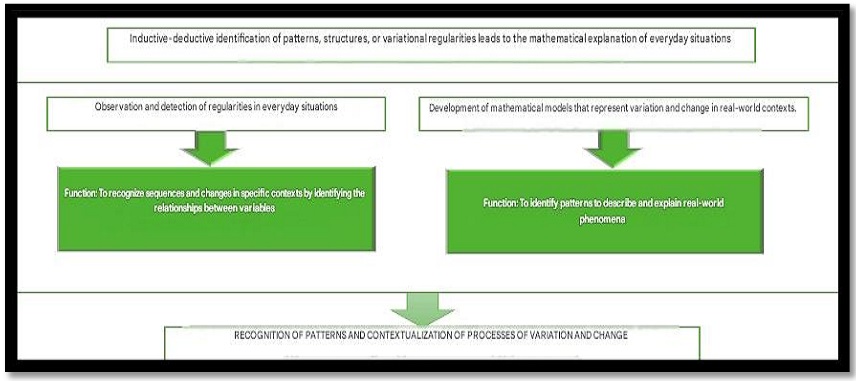
Its function is to enhance students' logical-mathematical reasoning through the exploration and generalization of patterns, both from specific observations (induction) and from general principles (deduction). This process allows students to move from the concrete to mathematical abstraction—and vice versa—in order to understand, explain, and predict phenomena in a logical and well-founded manner (see Figure 4). This function highlights the intrinsic connection between variational thinking and logical thinking, as the search for regularities requires both inductive inference and deductive validation.
Figure 4. Components of the inductive-deductive identification subsystem
Components:
Observation and detection of patterns in everyday situations.
Its purpose is to recognize sequences and changes in specific contexts, identifying relationships between variables. It focuses on observing phenomena that exhibit variations or repetitions in the student's environment, in order to discover systematic relationships that foster mathematical thinking. This involves organizing data into tables, graphs, or sequences; comparing values; describing relationships; and searching for numerical regularities or geometric patterns.
Development of mathematical models that represent variation and change in real-world contexts.
Its purpose is to identify patterns to describe and explain real-world phenomena, integrating observation, interpretation of relationships, and validation of results. It requires understanding, describing, predicting, and explaining phenomena in the environment through mathematical structures. Based on the identified patterns, a mathematical expression is established that describes the elements and variables that change or are related. This involves problematizing mathematical knowledge through tasks that reveal students' prior knowledge, fostering proactive, reflective, and creative attitudes toward model-building.
These components interact through a coordinated relationship. From this interaction arises the recognition of patterns in processes of variation and change. From a psychological perspective, this process stimulates the development of formal operations through reflective abstraction and hypothetical-deductive thinking—abilities that emerge during the upper elementary school years.
Pedagogical implications: Teachers should structure sequences of activities that promote progressive generalization, beginning with specific, concrete cases and moving toward general formulations. Collaborative work strategies should be implemented to facilitate the discussion and validation of conjectures, harnessing the potential of sociocognitive conflict for conceptual advancement.
Example of an activity: Based on the data from "Plant Growth," students: (a) formulate the general rule "height is equal to twice the number of weeks plus one" (induction); (b) apply the rule to calculate height for any given week (deduction); (c) validate the rule using known cases; (d) explain why the rule works. Common errors include premature generalizations without sufficient evidence and difficulties in understanding the status of variables in general expressions.
Development indicators: (1) Formulates general rules based on specific cases; (2) Applies general principles to specific situations; (3) Justifies the validity of generalizations; (4) Evaluates the consistency of identified patterns.
In general, it is important to note that the generalization and modeling skills proposed in the model do not arise spontaneously. They are the result of a careful scaffolding process by the teacher, who designs activities that fall within the students' Zone of Proximal Development. Generalizations, for example, are not expected to be formulated initially using formal algebraic language, but rather through verbal expressions, drawings, or gestures that demonstrate an understanding of the underlying rule, gradually progressing toward more conventional representations.
The transition toward gradual mathematical abstraction occurs through processes of reflective abstraction in which students, when faced with situations involving variation and change, reorganize their existing cognitive structures to construct new mental schemas that allow them to understand relationships beyond specific cases. The teacher's role in the Zone of Proximal Development is essential here: during the interpretation of processes of variation, for example, the teacher explicitly models the language used to describe changes ("Do you notice how the plant grows exactly the same amount each week?"), provides temporary scaffolding such as partially completed tables, and asks strategic questions that guide students' attention toward essential relationships. These supports are gradually withdrawn as students internalize the thought structures.
Levels of Development of Variational Thinking in the Second Cycle of Elementary School
Three progressive levels of development in variational thinking can be identified. These levels are not merely cumulative but represent a qualitative restructuring of students' abilities, evidenced by the complexity of coordination among the subsystems and the nature of the mathematical tasks they can tackle. The progression is characterized by a transition from situated and descriptive variational thinking to relational and flexible thinking, ultimately reaching systemic and argumentative variational thinking.
Level 1: Recognition and description of patterns in specific contexts.
At this initial level, the development of variational thinking is grounded in direct perception and concrete description. The "Interpretation" subsystem plays a dominant role, with emerging support from "Inductive Identification" processes. Modeling is still in its infancy and highly dependent on the immediate context.
Characterization of coordination between subsystems:
- Interpretation: The identification of perceptible changes (increases/decreases, grows/shrinks, next/previous) predominates in simple numerical patterns (e.g., 2, 4, 6, 8...) or geometric patterns (e.g., a row of squares that gets longer). Variation is perceived as a discrete state ("the next one is bigger") rather than as a continuous relationship.
- Inductive-Deductive Identification: Operates in a basic, inductive manner. Students detect patterns through repetition and trial and error, generalizing to very similar cases ("it always adds two"). Deduction from a general rule is practically nonexistent.
- Modeling: The variable is conceived primarily as a "general number" or a "changing value" within a single context. Representations (drawings, words, isolated numbers) are strongly tied to the specific situation, with no clear distinction between the context and the mathematical model.
Performance indicators:
- a) Describes changes in sequences using natural language and concrete references.
- b) Completes simple patterns based on the repetition of an element or a constant arithmetic operation (+2, -1).
- c) Identifies "what changes" and "what remains the same" in a given situation, but without explicitly establishing the relationship of dependence.
- d) Their representations (informal graphs, lists) are iconic and dependent on the specific case.
Example of a task: "Look at this sequence of figures made with tiles. Draw the next figure. Explain what you added to the previous one to create it."
Level 2: Establishing relationships and emerging modeling.
At this intermediate level, variational thinking is characterized by the active search for relationships and the ability to begin abstracting patterns into more general models. The "Interpretation" and "Inductive-Deductive Identification" subsystems coordinate more fluidly, and the "Modeling" subsystem takes center stage to account for the relationship between variables.
Characterization of coordination among subsystems:
- Interpretation: Progresses from describing states to understanding how changes are related. Students begin to verbalize relationships such as "for every X that increases this, Y increases that".
- Inductive-Deductive Identification: Inductive generalization strengthens, allowing patterns to be extended to non-immediate cases. The first attempts at deduction emerge: students apply a discovered rule (for example, "multiply by 3") to predict or justify terms further along in the sequence.
- Modeling: The meaning of the variable becomes more flexible. Students understand its use as an "unknown" in simple equations and as a "quantity that varies" in relation to another. Begins to consciously switch between modes of representation (for example, translating a situation into a table of values and then into an incipient symbolic expression, such as "number of tables × 4 = chairs").
Performance indicators:
- a) Formulates simple verbal or symbolic rules to describe the relationship between two variable quantities.
- b) Constructs and uses data tables to organize data and look for systematic patterns.
- c) Interprets and produces basic Cartesian graphs (discrete points) that represent the relationship between variables.
- d) Justifies predictions by referring to the identified rule or pattern, not just to perception.
Example of a task: "To organize the classroom, 4 students sit at each table. Complete the table that relates the number of tables to the number of students. Write an expression (formula) that allows you to calculate the number of students for any number of tables. Draw a graph with the results."
Level 3: Generalization, Argumentation, and Flexible Modeling.
At the most advanced level, variational thinking is consolidated as a system of abstract and reasoned argumentation. The three subsystems operate in an integrated and recursive manner, allowing students not only to apply but also to critique, adapt, and generate models to explain and predict phenomena.
Characterization of coordination among subsystems:
- Interpretation: Analyzes complex variation processes (with more than two variables or with non-constant rates of change) in diverse contexts. Anticipates global behaviors based on the relational structure.
- Inductive-Deductive Identification: Generalization becomes explicit and symbolic (for example, expressing the general rule as y = 4x). Uses deductive reasoning to validate conjectures and explain why a pattern works, connecting it to mathematical properties (for example, linearity).
- Modeling: Achieves complete flexibility in the use and representation of variables. Critically selects the most appropriate semiotic register for a given purpose (explaining, persuading, predicting). Evaluates the relevance and limitations of a mathematical model in relation to the real-world situation it represents.
Performance Indicators:
- a) Generalizes patterns using algebraic symbolic language appropriate for the level.
- b) Compare different models or representations of the same variational phenomenon and discuss their advantages.
- c) Formulate and validate conjectures about the behavior of a system under changing conditions ("What would happen if...?").
- d) Explain complex everyday situations (such as the growth of a plant over time or the relationship between perimeter and area) by constructing and refining their own simplified mathematical models.
Example of a task: "We investigate how many squares there are in staircases of different sizes. For a staircase with n steps, is there a formula that allows us to calculate the total number of squares without having to draw it? Compare your formula with that of a classmate. Are they equivalent? Prove it. Represent the relationship on a graph and explain what it tells us about how the figure grows."
The description of these three levels demonstrates how the didactic model not only describes components of variational thinking but also prescribes a learning trajectory. Progress from one level to another does not occur through the isolated addition of skills, but rather through the reorganization and greater synergistic integration of the subsystems of interpretation, modeling, and pattern recognition.
Thus, Level 1 reflects an initial, context-dependent interaction; Level 2, an operational coordination that enables relationships and basic modeling; and Level 3, a systemic integration that gives rise to variational thinking proper: generalizing, argumentative, and applied in a flexible and conscious manner. This progression provides a guide for formative assessment and the design of learning pathways that guide upper elementary students in the meaningful development of this fundamental way of thinking.
Theoretical Evaluation of the Instructional Model Based on Expert Criteria
The evaluation of the instructional model by the 36 experts revealed high levels of agreement across the four dimensions assessed. Table 1 presents the results of the evaluation:
| Assessed Dimension | Media | Typical Deviation | Coefficient of variation | Level of agreement |
|---|---|---|---|---|
| Theoretical Framework | 4.65 | 0.48 | 0.10 | Very High |
| Internal consistency | 4.52 | 0.56 | 0.12 | High |
| Contextual Relevance | 4.78 | 0.42 | 0.09 | Very High |
| Application relevance | 4.41 | 0.63 | 0.14 | High |
| Total | 4.59 | 0.52 | 0.11 | Very High |
In the theoretical foundation dimension, the experts particularly highlighted the coherent integration of psychological and didactic perspectives (mean = 4.65), noting that the model "effectively articulates Vygotskian principles with contemporary approaches to mathematics education" (Cuban expert in mathematics education with 35 years of experience) and "addresses real cognitive development needs within the target age range" (Dominican expert in elementary education).
Regarding internal coherence (mean = 4.52), the experts positively assessed the logical progression among the model's three processes and their interrelationships, although some noted the need to "further clarify the transitions between levels of development" (a Cuban expert in mathematics education with over 40 years of experience in teacher training). A Dominican educational supervisor with extensive experience in educational assessment suggested "strengthening the assessment indicators for each process".
Contextual relevance received the highest rating (mean = 4.78), with the model's suitability for the Dominican and Cuban educational contexts being highlighted. A Dominican expert specializing in primary education curriculum endorsed "the relevance of the proposed examples and their alignment with the official curriculum." A Cuban expert noted "the sensitivity to the cultural characteristics of Caribbean students."
Regarding application potential (mean = 4.41), while significant strengths were acknowledged, some experts pointed out practical challenges for implementation, particularly regarding "the specialized teacher training required" (Dominican expert) and "the need for specific teaching resources" (Cuban expert).
For the comparative analysis between Dominican (n=18) and Cuban (n=18) experts, the nonparametric Mann-Whitney U test was used, given its greater robustness for small sample sizes without assuming normality. No statistically significant differences were found in the overall ratings (U = 137.5, z = -1.18, p = 0.24), suggesting a unanimous perception of the model's quality. However, significant nuances were observed in specific dimensions. The Cuban experts rated the theoretical foundation significantly higher (AverageCuban experts = 4.81 vs AverageDominican experts = 4.49; U = 98.5, z = -2.09, p = 0.04), possibly reflecting their more established tradition in educational research. In contrast, Dominican experts rated contextual relevance higher (AverageDominican experts = 4.89 vs AverageCuban experts = 4.67; U = 94.0, z = -2.18, p = 0.03), demonstrating their greater sensitivity to the particularities of the Dominican educational system for which the model is designed or, possibly, reflecting differences in educational contexts and instructional priorities.
The experts' qualitative comments emphasized the model's practical feasibility, noting that "it constitutes a viable alternative for transforming mathematics instruction in elementary education" (Dominican expert in mathematics education with 18 years of experience in teacher training) and that "its psychological foundations are consistent with current evidence on cognitive development in mathematics" (Cuban expert in mathematics education with 25 years of experience). As suggestions for improvement, the experts mentioned the need to "develop specific support materials for teachers" (a Cuban expert in pedagogy and psychology) and to "establish mechanisms for monitoring and evaluating the model in real-world contexts" (a Dominican expert in mathematics education with 13 years of experience in primary school teacher training).
Conclusions
This study made it possible to establish, develop, and evaluate a teaching model for fostering variational thinking among students in the second cycle of elementary school, integrating up-to-date psychological, pedagogical, and curricular perspectives. The specific conclusions highlight the following:
- The integration of psychological foundations (Vygotsky's sociocultural theory, Duval's theory of semiotic representation) with contemporary didactic approaches (early algebra, mathematical modeling) provides a solid theoretical basis for the development of variational thinking in elementary education, addressing the characteristics of cognitive development in the 8–12 age range.
- The didactic model, structured into three interrelated subsystems (interpretation of variation and change, situational mathematical modeling, inductive-deductive pattern identification), offers a coherent and progressive alternative to guide the development of variational thinking, with concrete examples illustrating its implementation in real classroom contexts.
- Expert evaluation confirms the model's relevance, coherence, and feasibility, with high levels of agreement across all assessed dimensions—particularly in theoretical foundation and contextual relevance—supporting its potential to transform mathematics teaching practices in elementary education.
- The model's emergent quality—the logical significance of processes of variation and change—constitutes the central response to the theoretical and didactic gap identified in the introduction. By dialectically integrating interpretation, modeling, and generalization, the model enables students not only to perform procedures but also to meaningfully understand the relationships of change, thereby endowing mathematical learning with a logical coherence that goes beyond mere mechanization.
- The practical implications of this study include: (1) the need to develop teacher training programs specializing in variational thinking and its psychological foundations; (2) the advisability of designing specific instructional resources that embody the model's processes in diverse classroom situations; (3) the importance of implementing monitoring and evaluation systems that allow the model to be adjusted based on the results of its application in real-world contexts.
References
- Báez, A. M. & Gómez Muñoz, H. (2025). Dificultades en el diseño de tareas matemáticas de desarrollo procedimental de procesos de variación y cambio: un estudio con docentes dominicanos. Transformación, 21, e486. https://transformacion.reduc.edu.cu/index.php/transformacion/es/article/view/486/561
- Contreras-Jaimes, K. Y., Martínez-Aguilar, J. P., & Prada-Núñez, R. (2020). Intervención pedagógica tendiente a desarrollar el pensamiento variacional en estudiantes de educación básica primaria. Eco Matemático, 11(3), 91–104. https://doi.org/10.22463/17948231.2913
- Doncel González, K. J., Rodríguez-Hernández, A. A., & Melo Niño, D. S. (2022). Modelando patrones en Scratch: Estrategia de apoyo al pensamiento variacional. Revista Boletín Redipe, 11(3), 301–315. https://revista.redipe.org/index.php/1/article/view/1722
- Duval, R. (1999). Representation, vision and visualization: Cognitive functions in mathematical thinking. En Proceedings of the Annual Meeting of the North American Chapter of the International Group for the Psychology of Mathematics Education (21st, Cuernavaca, México). ERIC Document Reproduction Service No. ED466379. https://eric.ed.gov/?id=ED466379
- Espindola Artola, A., López Mejías, M., & Rodríguez Pupo, N. (2025). Estrategia didáctica para el desarrollo de la memoria lógico-verbal en la sistematización de ejercicios básicos de multiplicación. Edma 0-6: Educación Matemática en la Infancia, 14(2), 163-196. https://revistas.uva.es/index.php/edmain/es/article/view/9908/7303
- Guerrero-Morales, L. & Falk de Losada, M. (2023). Una mirada a la teoría de representaciones semióticas de Duval desde el contexto educativo. South Florida Journal of Development, 4(3), 305–314. https://southfloridapublishing.com/ojs/index.php/jdev/article/view/3054
- Hernández-Sampieri, R., Fernández-Collado, C., & Baptista-Lucio, M. del P. (2014). Metodología de la investigación (6.ª ed.). McGraw-Hill Interamericana Editores.
- Ibarra Rivas, L. R. (2021). Pensar Pedagógico y Pensar Concreto-Abstracto. Dilemas contemporáneos: educación, política y valores, 9(spe1), 00015. https://doi.org/10.46377/dilemas.v9i.2920
- Inhelder, B. & Piaget, J. (1981). Epistemología genética. Fondo de Cultura Económica. https://repositorio.esocite.la/631/1/Inhelder-Garcia-Voneche1981-PiagetEpistemologiaGenetica.pdf
- Lizana Chauca, D. & Antezana Iparraguirre, R. P. (2021). Representación semiótica en el aprendizaje de conceptos básicos de la estructura algebraica de grupo. Horizonte de la Ciencia, 11(21), 177–188. https://revistas.uncp.edu.pe/index.php/horizontedelaciencia/article/view/1394
- Martínez, S., Pérez, A., & Valdés, M., B. (2022). Juegos didácticos para el aprendizaje de las magnitudes en la educación primaria. Revista Conrado, 18(87), 451-459. http://scielo.sld.cu/scielo.php?script=sci_arttext&pid=S1990-86442022000400451
- Ministerio de Educación de la República Dominicana. (2018). Evaluación Diagnóstica Nacional 2018: Sexto grado de primaria. Dirección de Evaluación de la Calidad Educativa. https://www.ministeriodeeducacion.gob.do/sobre-nosotros/areas-institucionales/direccion-de-evaluacion-de-la-calidad/informe-de-evaluacion-diagnostica-6to-grado
- Ministerio de Educación de la República Dominicana. (2022). Evaluación Diagnóstica Nacional 2022: Resultados de sexto grado de primaria. Dirección de Evaluación de la Calidad Educativa. https://www.ministeriodeeducacion.gob.do/docs/direccion-de-evaluacion-de-la-calidad/vpdP-informe-evaluacion-diagnostica-2022-6to-de-primariapdf.pdf
- Parra-Arenales, I. M., Martínez-Delgado, W. A., & Gualdrón-Pinto, É. (2021). Fortalecimiento del pensamiento variacional a través de la gamificación y la teoría de la objetivación. Revista Boletín Redipe, 10(12), 216–229. https://revista.redipe.org/index.php/1/article/view/1581
- Pincheira Hauck, N. & Alsina, A. (2021). Hacia una caracterización del álgebra temprana a partir del análisis de los currículos contemporáneos de Educación Infantil y Primaria. Educación Matemática, 33(1), 153-180. https://doi.org/10.24844/EM3301.06
- Vygotsky, L. S. (1978). El desarrollo de los procesos psicológicos superiores. Editorial Crítica. https://saberespsi.wordpress.com/wp-content/uploads/2016/09/vygostki-el-desarrollo-de-los-procesos-psicolc3b3gicos-superiores.pdf
Acknowledgments:
This work was made possible thanks to funding from the research project "The Development of Variational Thinking and Its Relationship to Mathematics Learning at the Elementary Level" (code VIR-PI-8-2024-004), sponsored by the Salomé Ureña Higher Institute for Teacher Training (ISFODOSU) and carried out at the Emilio Prud'Homme Campus in Santiago de los Caballeros, Dominican Republic.
Conflict of interest:
The authors declare that they have no conflicts of interest. The funding received from the Salomé Ureña Higher Institute for Teacher Training (ISFODOSU) for project VIR-PI-8-2024-004 did not involve any interference in the study design, data collection or analysis, interpretation of results, or the drafting of this manuscript.
Curricular synthesis:
Ana Mercedes Báez, Industrial Engineer. Ph.D. in Pedagogical Sciences. Master's in Pure Mathematics, specializing in Applied Mathematics.
Heidy Gómez Muñoz, Bachelor of Education with a concentration in Mathematics. Master's Degree in Mathematics for Educators.
Arnaldo Espindola Artola, Ph.D. in Pedagogical Sciences. Master's Degree in Mathematics Education. Full Professor. Senior Researcher.
Author Responsibility Statement:
Ana Mercedes Báez: Conceived the research idea. Participated in the literature review and the writing of the article.
Heidy Gómez Muñoz: Participated in the literature review and data curation. Wrote the original manuscript and conducted the analysis and interpretation of the results.
Arnaldo Espindola Artola: Designed the research methodology. Participated in the literature review, the preparation and processing of the results, and their interpretation.
Edited by: M. Sc. Gilda Jiménez Montejo.
This is an Open Access article distributed under the terms of the Creative Commons License:
https://creativecommons.org/licenses/by-nc/4.0/deed.es_ES
which allows for non-commercial use, distribution, and reproduction without restrictions in any medium, provided that the primary source of publication is properly cited.