Teachers' development in the didactic management of competency-based education
La formación continua de los docentes para la gestión didáctica del desarrollo de competencias
2 Educational District 03-04, Azua de Compostela, Azua Province, Dominican Republic.
3 Center for Educational Studies Enrique José Varona, University of Camagüey, Cuba.
Introduction: Teachers' development is an indispensable prerequisite for updating approaches and methods at school.
Objective: The paper aims to devise a system for teachers' development in the didactic management of competency based education.
Method: A qualitative methodology was used to carry out the research. Theoretical-level methods such as analysis-synthesis and induction-deduction were applied to examine theoretical references; the hypothetical-deductive method was used to verify proposed solutions, along with the systemic-structural-functional approach and modeling to devise teacher's development. At the empirical level, methods included literature review to analyze information related to the topic and critical opinion workshops and collective construction sessions to assess the proposed model from a theoretical prescriptive perspective.
Results: The main outcome is the description of a system for teachers development in the didactic management of competency based education.
Conclusions: The research proposes the creation of a system for teachers development in the didactic management of competencies based on the principles of school-centered training through the creation of a learning community, students' and teachers' needs, as well as cognitive, procedural, and attitudinal requirements. This model is feasible for practical application in individual and collective teachers' continuous education.
Introducción: La formación continua de los docentes es un prerequisito indispensable para la actualización de enfoques y métodos en la escuela.
Objetivo: La investigación tiene como objetivo: proponer un modelo de formación continua de docentes para la gestión didáctica del desarrollo de competencias.
Método: Para el desarrollo de la investigación se siguió una metodología cualitativa. Se utilizaron métodos del nivel teórico como el análisis-síntesis y la inducción-deducción para el análisis de los referentes teóricos; el hipotético deductivo para la verificación de las soluciones propuestas; el sistémico estructural funcional y la modelación para el diseño del modelo. Como métodos del nivel empírico se utilizaron la revisión bibliográfica para el estudio de la información relacionada con el tema y los talleres de opinión crítica y construcción colectiva y el pre-experimento pedagógico para valorar desde la perspectiva teórica el modelo propuesto. A partir de la concepción teórica del modelo presentado, se diseñaron y aplicaron estrategias específicas para el desarrollo de la competencia ambiental –en el nivel Primario– y de la competencia comunicativa –en el nivel Secundario–, a través de pre-experimentos pedagógicos efectuados en centros educativos seleccionados del Distrito 01-03 de Azua de Compostela, Provincia Azua y en el Distrito Educativo 18-01, Neiba, Provincia de Bahoruco, respectivamente.
Resultados: El principal resultado es el modelo de formación continua de docentes para la gestión didáctica del desarrollo de competencias.
Conclusiones: La investigación realizada propone un modelo de formación continua de docentes para la gestión didáctica del desarrollo de competencias, que tienen en cuenta los presupuestos de la formación centrada en la escuela, a través de la creación de una comunidad de aprendizaje, a partir de las necesidades formativas de los estudiantes y los profesores, y de las necesidades cognitivas, procedimentales y actitudinales que se presentan en la ejecución práctica del proceso de gestión. La introducción práctica del modelo favoreció la preparación individual y colectiva de los docentes.
Introduction
Teachers' continuing education is essential to ensure they are updated on new pedagogical approaches and educational methodologies. As society evolves and students' needs change, teachers must adapt and improve their knowledge, skills, and attitudes. Thus, continuing education provides them with the necessary tools to face current educational challenges and offer quality teaching that promotes the comprehensive development of students.
In the Dominican Republic, competencies occupy a central place in students' academic and personal training. Thus, the Curricular Adaptation for primary and secondary levels (Viceministry of Technical and Pedagogical Services. General Directorate of Curriculum, 2023) includes competencies, which are considered cross-curricular axes, meaning all subjects must contribute to them. However, deficiencies are observed in teacher training to face the didactic management of these competencies through the teaching-learning process of the subjects they teach.
Matos (2017) addresses insufficiencies in the development of competencies in the Dominican Republic in his work. He emphasizes the need to address this aspect both in initial and continuing education of teachers at all educational levels, as teachers predominantly lack knowledge of didactic strategies for addressing cultural and learning diversity among students, as well as little disposition to approach them from teaching.
Regarding authors who have worked on teacher continuing education, the literature consulted highlights the works of Cano (2015), Domingo-Coscollola et al. (2022), Mayorga et al. (2024), Souto-Seijo et al. (2020), Vezub (2024), Yan et al. (2022), and Willatt (2024), who, although they make contributions that serve as references for this research, do not address teacher preparation for the didactic management of competencies.
Regarding the didactic treatment of competency development, the works developed by Romeu (2014), Sánchez et al. (2023), and Vila et al. (2023) are taken as references in this research.
Among practicing teachers, difficulties are observed in the didactic management of competency development from a theoretical and methodological perspective, as well as the prevalence of a reductionist view of the incidence of areas or subjects that should contribute to said process, and consequently in the development of these competencies by students.
The article aims to propose a model for teachers' continuing education for the didactic management of competency development.
Methodology
The research used a qualitative methodology. In that order, through methods such as analysis-synthesis and induction-deduction, the conceptual, factual, and phenomenological interrelationships related to the object of the research were established. For its part, the hypothetical-deductive method was used to verify the proposed solutions to the problems found, while the systemic-structural-functional and modeling methods were used for the design of the model. At the empirical level, bibliographic review was used, which allowed the study and collection of information related to the topic, both from the point of view of the contributions of the different authors consulted, and of the current provisions in the Dominican Republic in this regard. The critical opinion and collective construction workshops allowed evaluating the reliability of the practical instrument to be used in the implementation of the model. Through two pedagogical pre-experiments, the feasibility and effectiveness of the proposal were assessed from a theoretical and practical perspective.
Results
The model for teachers' continuing education for the didactic management of competency development aimed to remedy the theoretical limitations that gave rise to this research. In that order, the model was based on the following assumptions:
- It is aimed at training the knowledge, skills, and attitudes that teachers need to manage the development of competencies from the teaching-learning process of the subjects they teach (Cano, 2015; Domingo-Coscollola, 2022; López et al., 2021; López, 2022; Romeu, 2014; Sánchez et al., 2023; Vila et al., 2023).
- It projected the establishment of constant interrelationships among grade teachers, through the creation of professional learning communities (Vezub, 2024), mediated by ethical and affective communication, where values such as respect and responsibility should be manifested (Vygotsky, 1995).
- Special attention was given to the teacher's personal and social (classroom) context, which is why it was considered the starting point of continuing education (Yan et al., 2022).
- It was conceived through the teacher's performance in the teaching-learning process (Chala et al., 2021; and Vezub, 2024), thus linking the theory they need to master with their pedagogical practice as a manifestation of school-centered continuing education (Domingo-Coscollola, 2022).
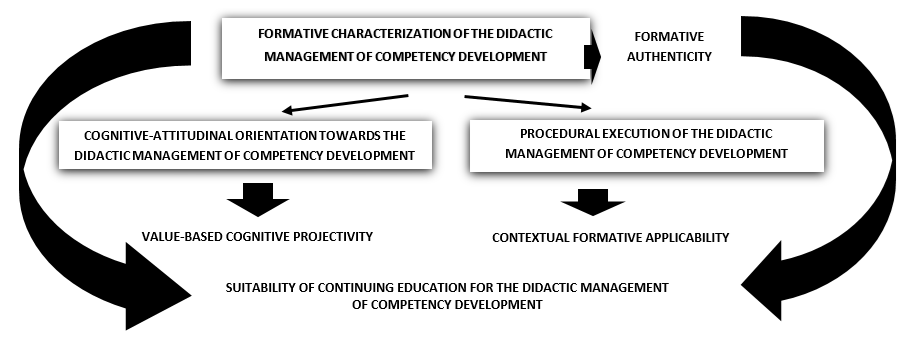
Based on the aforementioned assumptions, the model was structured into three subsystems: the subsystem Formative characterization of the didactic management of competency development, the subsystem Cognitive-attitudinal orientation towards the didactic management of competency development, and the subsystem Procedural execution of the didactic management of competency development, which are argued below:
Subsystem: Formative characterization of the didactic management of competency development
The formative characterization subsystem of the didactic management of competency development has the function of determining the stage in which both students and teachers find themselves to face the process from the different subjects taught in each cycle or grade.
The results of this characterization are the starting point of teachers' continuing education, since, based on this, the actions to be developed by the learning community created for this purpose are projected.
The subsystem was composed of two components:
- Characterization of the students' level of competency development.
- Characterization of teachers' preparation to manage competency development from a didactic perspective.
The component Characterization of the students' level of competency development has the function of determining the behavior in each of them of the performance criteria established for each particular competency and the level or grade in which they are located. The process is led by the teacher who is at the head of the learning community and in which both students and the rest of the teachers participate.
Student participation is carried out, essentially, through the realization of a self-diagnosis, where individually they come to determine their formative needs in this regard, in order to actively involve them in their own formative process, based on the needs they themselves detect.
Teachers participate in the characterization of students through a diagnosis where, in a group (cycle or year teachers), they determine the level of development achieved by students regarding the competency being worked on.
Teachers' participation in the characterization of the students' level of development fosters their awareness of the need for adequate management from the area of knowledge they work in, as well as the determination of the deficiencies they present from the didactic perspective to face that process.
The component Characterization of teachers' preparation to manage competency development from a didactic perspective has the function of determining the prior preparation of teachers, in order to detect the difficulties they present in their performance and, based on them, project the necessary actions from the formative perspective, through the learning community created for this purpose.
To carry out the characterization, teachers must conduct a self-diagnosis based on two essential aspects: their considerations about their preparation to face the difficulties presented by their students, as well as their performance related to the planning, execution, and evaluation of activities aimed at competency development.
From the results of the self-diagnosis, each teacher initially determines their needs, which should be assessed in the learning community to project individual and group preparation actions.
Between the components Characterization of the students' level of competency development and Characterization of teachers' preparation to manage it from a didactic perspective, coordination and complementarity relationships are established, as they provide mutual elements. In that order, the characterization of the students' level of development is an indicator of the elements in which teachers should be prepared and is a factor that can influence their awareness to face didactic management. For its part, the characterization of teachers' preparation allows continuing education to be aimed at solving the difficulties presented by students.
From the synergistic relationships established between both components arises the quality Formative authenticity, which is that which expresses the projection of continuing education attending to the needs of teachers, to respond to the deficiencies that students present in the development of competencies.
Subsystem: Cognitive-attitudinal orientation towards the didactic management of competency development
Cognitive-attitudinal orientation towards the didactic management of competency development is the subsystem whose function is the preparation of teachers from the theoretical and attitudinal perspective, taking into account the results of the Formative characterization subsystem of the didactic management of competency development.
The subsystem is composed of two components:
- Cognitive orientation towards the theoretical assumptions of didactic management for competency development.
- Attitudinal orientation towards didactic management for competency development.
Cognitive orientation towards the theoretical assumptions of didactic management for competency development is the component whose function is for teachers to appropriate the necessary knowledge that guarantees their correct performance to achieve the required levels in their students in this regard.
In that order, teachers must possess knowledge related to the content of the curricular area they teach, with the theoretical, pedagogical, didactic, and curricular treatment of competencies, as well as the assumptions of didactic management.
This component should be developed through self-management of knowledge by teachers, as well as through workshops or other forms of collective preparation in the learning community, whenever the training needs are of the majority of the group that comprises it.
Attitudinal orientation towards didactic management for competency development is the component whose function is for teachers to reflect and appropriate during their training process, consciously and consensually, the attitudes they must assume, so that through the affective assessment of their practices they self-regulate their teaching performance.
Through this component, during workshops and other participatory activities, teachers reflect on their attitude, which should favor self-examination in exchange and feedback with the other teachers who make up the learning community.
Among the essential attitudes that teachers must assume are the willingness to face the process of developing their students' competencies and the creation of an atmosphere of trust in the classroom, as a basic need for communication.
Between the components Cognitive orientation towards the theoretical assumptions of didactic management for competency development and Attitudinal orientation towards didactic management for competency development, coordination and complementarity relationships are established as they provide mutual elements for their conformation. Cognitive orientation provides greater objectivity to attitudinal orientation, as teachers have the necessary knowledge that allows them to assess their attitude and consider the theoretical assumptions involved in the didactic management of competencies. For its part, attitudinal orientation favors cognitive orientation, by enabling the teacher's motivation towards their preparation from the theoretical perspective.
From the synergistic relationships established between the components of the subsystem arises Theoretical-value formative projectivity, which is the quality that indicates the adequate gnoseological and attitudinal preparation of teachers to effectively face their pedagogical practice aimed at didactic management for competency development, attending to their formative needs.
Subsystem: Procedural execution of the didactic management of competency development
The subsystem Procedural execution of the didactic management of competency development has the function of training and developing skills in the teacher based on their own practice, through their performance, in carrying out actions related to the procedures that affect the planning, execution, and evaluation of competency development from the area of knowledge they teach.
In that order, the development of procedures related to the planning, execution, and evaluation of competency development fosters the reworking of related knowledge and attitudes, since it is in practice where these are concretized.
Procedural execution should be mediated by the teacher's self-evaluation of their own practice, as well as by hetero-evaluation and co-evaluation, through the presentation of individual experiences in the workshops held in the learning community.
The subsystem is composed of the following components:
- Formative planning of competency development.
- Formative execution of competency development.
- Formative evaluation of competency development.
Formative planning of competency development is the component whose function is the preparation of teachers to develop in the teaching-learning process of the area of knowledge they teach, taking into account the related knowledge and attitudes.
The essential procedural content of this component is the following:
- Diagnosis of the students' level of competency development, considering the performance criteria established for the level or grade in which they are located.
- Design of tasks and exercises in the area of knowledge they teach, aimed at remedying the difficulties presented by students, detected in the diagnosis, that motivate their daily learning.
- Definition –from the perspective of the competency being worked on– of the objectives, content, teaching aids, method(s) and strategies, as well as the new concepts to be introduced and taught within the context of the task or exercise and relate them to new concepts.
- Definition of evaluation forms considering the performance criteria related to the competency that students are expected to achieve.
Formative execution of competency development is the component whose function is the preparation of the teacher, through practice, for the execution and implementation of the activities to be developed in the teaching-learning process of the area of knowledge they teach, which were previously designed considering the related knowledge and attitudes.
The essential procedural content of this component is the following:
- Orientation of the task or exercise, explaining to students its objectives, content, way of realization, evaluation, and its indicators, based on the planned performance criteria.
- Observation of the phases or moments of the didactic treatment of the competency being worked on.
- Guidance for students to create their own strategies to solve the situations presented.
- Permanent observation and direction of students' work.
Formative evaluation of competency development is the component whose function is the teacher's execution of the evaluation of the activities developed in the teaching-learning process of the area of knowledge they teach, which were previously designed, considering the related knowledge and attitudes. Formative evaluation favors the improvement of the planning and execution of didactic management.
The essential procedural content of this component is the following:
- Development of the evaluation of the competency shown by each student during the execution of the tasks, exercises, and upon its conclusion, according to the preset performance criteria.
- Use of self-evaluation, co-evaluation, and hetero-evaluation.
- Provision of recommendations or new tasks, if necessary, in order to eliminate the difficulties shown by the students.
Between the components of the subsystem, subordination and complementarity relationships are established, as the phases of didactic management are subordinated to each other and in turn provide elements for their improvement. In that order, formative execution and formative evaluation depend on planning, because what is planned is executed and evaluated; however, the results of execution and evaluation have an impact on planning, since as processes they can evidence the need to conceive new activities, based on the results shown by the students and repeat the cycle if necessary.
From the synergistic relationships established between the components of the subsystem, the quality Contextual formative applicability arises, as a practical expression of the training achieved by teachers to assume the didactic management of competency development in their students.
In turn, between the subsystem Formative characterization of the didactic management of competency development and the subsystems Cognitive-attitudinal orientation and Procedural execution, subordination relationships are established, since the latter two depend on the former, as it is the starting point of the formative process.
Between the subsystem Cognitive-attitudinal orientation… and the subsystem Procedural execution… coordination and complementarity relationships are established, as they provide mutual elements. The cognitive-attitudinal orientation provides the essential elements from the theoretical and evaluative perspective for the correct practical development of didactic management, and the latter enables the improvement of knowledge and values, considering that it is in practical activity where these are evidenced.
From the relationships established between the subsystems of the model arises the quality Suitability of continuing education for the didactic management of competency development, as an expression of the materialization in practice of knowledge related to its planning, execution, and evaluation from the teaching-learning process of the different areas of knowledge taught, based on its contextualization (Figure 1).
The model was assessed from a theoretical perspective through critical opinion and collective construction workshops, following the assumptions proposed by Cortina and Trujillo (2009). The objective of the workshops was to socialize the proposal and obtain, through collective analysis, reliable criteria on its relevance that would allow its improvement.
Three workshops were held, and the final criteria of the participating specialists coincided in recognizing that the proposal is viable and can be implemented to contribute to the continuing education of teachers for the development of competencies from the teaching-learning process of the subjects they teach.
Based on the theoretical conception of the presented model, specific strategies were designed and applied for the development of environmental competence –at the Primary level– and communicative competence –at the Secondary level–, through pedagogical pre-experiments carried out in selected educational centers of District 01-03 of Azua de Compostela, Azua Province and in Educational District 18-01, Neiba, Bahoruco Province, respectively.
As a result of the pre-experiments, the transformations in both teacher performance and the development of competencies –environmental and communicative– in students were manifested. The teachers showed mastery of current curricular provisions, as well as the theoretical, methodological, and praxeological assumptions of the competency they worked on and its didactic management. However, some difficulties were outlined especially in procedural execution, so it was necessary to make recommendations to continue the work. In the case of the students, the majority managed to move from the basic or initial level of competency development, in which they were at the beginning of the pre-experiment, to a satisfactory level.
Discussion
In the proposed model, in addition to assuming the criteria of Romeu (2014), Sánchez et al. (2023), Vila et al. (2023) related to the didactic treatment of competencies, the continuing education of teachers is addressed (Cano, 2015; Domingo-Coscollola et al., 2022; Mayorga et al., 2024; Souto-Seijo et al., 2020; Vezub, 2024; Yan et al., 2022; Willatt, 2024) so that they manage to develop competencies through the teaching-learning process of the subjects they teach.
Although it is necessary to continue the application of strategies based on the proposed model, to generalize it in the didactic management of all transversal competencies recognized by the Dominican curriculum at the different educational levels, as well as the need to delve into the potential of other methods for the development of school-centered continuing education –such as the use of Artificial Intelligence both for competency development and for teacher training and the preparation of teachers in training in this regard, among other issues– the research shows that the proposal made is a feasible way to achieve the transformation of the continuing education process of the teachers involved.
Conclusions
The model for teachers' continuing education for the didactic management of competency development is aimed at contributing to the solution of a problem that exists in the Dominican educational system, and which, in turn, from the study carried out, shows limitations from the perspective of its theoretical treatment.
The model considers the assumptions of school-centered training, through the creation of a learning community, where based on the training needs of students and teachers, as well as the cognitive, procedural, and attitudinal needs that arise in the practical execution of the management process, teachers prepare individually and collectively.
Both the critical opinion and collective construction workshops, as well as the pedagogical pre-experiments carried out, evidenced the relevance, feasibility, and effectiveness of the application of the proposals, in terms of improving the didactic management of competency development, through the continuing education of teachers for this purpose.
References
- Cano, J. M. (2015). Gestión didáctica. Madrid, España: Pearson.
- Chala, P. A., Castañeda-Peña, H., Rodríguez-Uribe, M., y Salazar-Sierra, A. (2021). Práctica pedagógica de docentes en formación como práctica social situada. Educación Y Educadores, 24(2), 221–240. https://doi.org/10.5294/edu.2021.24.2.3
- Cortina, V., y Trujillo, Y. (2009). Talleres de opinión crítica y construcción colectiva: Un método para corroborar resultados en la investigación pedagógica [Ponencia]. Congreso Internacional Pedagogía 2009. La Habana, Cuba.
- Domingo-Coscollola, M., Onsès-Segarra, J., y Sancho-Gil, J. M. (2022). Aprendizaje del profesorado de secundaria: entornos, especificidades y consideraciones para la práctica educativa. EDUCAR, 58(1), 53–68. https://doi.org/10.5565/rev/educar.1338
- López, E., Gutiérrez, B., Otero, A., y Expósito, E. (2022). Análisis cualitativo del perfil profesional del buen docente de educación secundaria. Revista Española de Pedagogía, 80(283), 493–516. https://revistas.unir.net/index.php/rep/article/view/148
- López, F., García, I., y Expósito-Casas, E. (2021). Formación inicial y formación permanente del profesorado de educación secundaria en España. Bordón. Revista De Pedagogía, 73(4), 65–84. https://doi.org/10.13042/Bordon.2021.91081
- Matos, P. (2017). La formación de docentes en la República Dominicana: Un reto para las instituciones de educación superior. Revista AULA, 61(1), 58-64. https://repositorio.unphu.edu.do/bitstream/handle/123456789/777/La formación de docentes en la República Dominicana.pdf?sequence=1
- Mayorga, M. J., Martínez, I., y Núñez, F. (2024). La formación permanente en el profesorado de enseñanza no universitaria: análisis de impresiones, preferencias y necesidades. Revista Española de Pedagogía, 82(288), 395–416. https://revistas.unir.net/index.php/rep/article/view/94.
- Romeu, A. (2014). Periodización y aportes del enfoque cognitivo, comunicativo y sociocultural de la enseñanza de la lengua. Revista Varona, 58(enero-junio), 32-46. https://www.redalyc.org/pdf/3606/360634165004.pdf
- Sánchez, S., Pascual, M. Á. y Fombona, J. (2023). Serious games: efectos en la competencia lingüística a partir de las diferencias socioeducativas del alumnado. Revista Complutense de Educación, 34(4), 769-781. https://doi.org/10.5209/rced.80052.
- Souto-Seijo, A., Estévez, I., Iglesias, V., y González-Sanmamed, M. (2020). Entre lo formal y lo no formal: un análisis desde la formación permanente del profesorado. EDUCAR, 56(1), 91–107. https://doi.org/10.5565/rev/educar.1095.
- Vezub, L. (2024). La política de formación continua en Argentina: opiniones de directivos de educación secundaria sobre las actividades y necesidades de formación y formación y desarrollo profesional docente. Revista Electrónica Interuniversitaria de Formación del Profesorado, 27(1), 45–60. https://doi.org/10.6018/refiop.596501
- Viceministerio de Servicios Técnicos y Pedagógicos. Dirección General de Currículo (2023). Adecuación Curricular Nivel Secundario. https://www.educando.edu.do/portal/wp-content/uploads/2023/10/3-Adecuacion-Nivel-Secundario-Oct-2023-Final.pdf
- Vila, P., Velasco, J. W., y Vila, P. (2023). Formación y formación y desarrollo de la competencia comunicativa en educación superior. Horizontes. Revista de Investigación en Ciencias de la Educación, 7(31), 2583–2596. https://doi.org/10.33996/revistahorizontes.v7i31.686
- Vygotsky, L. S. (1995). Pensamiento y Lenguaje. Ediciones Fausto.
- Willatt, C. (2024). De la observación de aula a la mirada pedagógica. Una reorientación fenomenológica. Revista de Investigación Educativa, 42(2), 1-18. https://doi.org/10.6018/rie.565331
- Yan, Z., Chiu, M. M. y Cheng, E. C. K. (2022). Predicting teachers' formative assessment practices: Teacher personal and contextual factors. Teaching and Teacher Education, 114, 1–13. https://doi.org/10.1016/J.TATE.2022.103718
Conflict of interest:
It is declared that there are no conflicts of interest that could have influenced the results obtained or the interpretations proposed.
Statement of author responsibility:
Gloridelis Sena Cuevas. Contributed to the conceptualization, data curation, formal analysis, modeling, and its experimental introduction in the continuing education of a group of secondary level teachers for the didactic management of the development of communicative competence.
M. Sc. Yenny Tejeda. Contributed to the conceptualization, data curation, formal analysis, modeling, and its experimental introduction in the continuing education of a group of primary level teachers for the didactic management of the development of environmental competence.
Marylú Núñez Morales. Had the methodological direction of the research, contributed to the conceptualization and modeling of the result, and supervised the introduction of the model into educational practice.
Edited by: Dr. C. Manuel N. Montejo Lorenzo, translation by BA. Yailén Fernández Daniel
This is an Open Access article distributed under the terms of the Creative Commons License:
https://creativecommons.org/licenses/by-nc/4.0/deed.es_ES
which permits non-commercial use, distribution, and reproduction without restrictions in any medium, provided the primary source of publication is properly cited.