Family education: development of mental health care competence
La educación familiar: formación de la competencia atención a la salud mental
2, 3 University of Camagüey Ignacio Agramonte Loynaz, Camagüey, Cuba.
Introduction: Family education prepares its members to foster the proper upbringing and personality development of children, adolescents, and young people.
Objective: To describe the competence mental health care as a component of the medical education process for family education.
Methods: A qualitative approach was used. Theoretical-level methods employed included analysis-synthesis and the historical-logical. Empirical-level methods included observation, interviews, and systemic-structural modeling used in describing the competency structure.
Result: The main finding is the description of the mental health care competency, based on contextual problems, its identification, assessment performance criteria and evidence. This competency enables successful performance in family education.
Conclusion: Developing competence in mental health care enhances the performance of Comprehensive General Medicine specialists regarding the family education process they must carry out in the community.
Introducción: La educación familiar prepara a sus miembros para promover una adecuada formación y desarrollo de la personalidad de niños, adolescentes y jóvenes.
Objetivo: Describir la competencia atención a la salud mental como componente del proceso de formación de los especialistas en Medicina General Integral para la educación familiar.
Métodos: Desde un enfoque cualitativo se emplearon como métodos del nivel teórico: el análisis-síntesis y el histórico-lógico. Como métodos del nivel empírico: la observación, la entrevista, y la modelación sistémico-estructural en la descripción de la estructura de la competencia.
Resultado: En el proceso de investigación se obtiene como principal resultado la descripción de la competencia atención a la salud mental a partir de los problemas contextuales, su identificación, los criterios de desempeño para la evaluación y las evidencias. Esta competencia permite el desempeño exitoso en el proceso de educación familiar.
Conclusión: La formación de la competencia: atención a la salud mental favorece el desempeño de los especialistas en Medicina General Integral en el proceso de educación familiar en la comunidad.
Introduction
Family education prepares its members to promote adequate personality formation and development in the children, adolescents, and young people under their care. This helps solve problems not only within the family, but also in the community where they live together, thus turning the members of these families into agents of change and promoters of development, not only in their homes but also in the community.
In this sense, the family constitutes the first and most lasting context of human development, configuring the foundations upon which mental health is built throughout life. Family education, understood as the intentional and systematic process through which families develop parental and relational competencies, emerges as a fundamental pillar for the promotion of psychological well-being. This theoretical foundation is based on the premise that mental health is built upon the basis of family love, emotional well-being, and conscious educational practices (Becerra, 2025).
The foundations of family education for mental health focus on the fact that the family is the first space for socialization, where clear and respectful communication allows emotions and needs to be expressed without fear, which prevents the accumulation of tensions and favors the search for shared solutions. In this direction, teaching socio-emotional skills at home also helps everyone regulate and express their emotions in a healthy way. This reduces the incidence of problems such as anxiety or depression.
This is why educational styles based on affection, reasoned discipline, and accompaniment are needed, which strengthen children's self-esteem and resilience and generate a protective environment against risk factors. Hence, the family, as an interdependent system, can implement healthy routines, recreational activities, and spaces for dialogue that promote well-being and prevent disorders.
Family education provides tools for parents to understand their children's mental development. This allows responses in a sensitive manner, attuned to the stage of life they are in, and thus helps form the foundations for self-confidence and adequate self-esteem.
In accordance with the above, it is necessary to start from the analysis that mental health problems are today very common in all countries of the world. Most societies and social health systems neglect mental health. Mental health is much more than the absence of disease; it is an intrinsic part of our individual and collective health and well-being (World Health Organization, 2023). This organization conceives mental health as a state of well-being in which the person realizes their abilities, copes with the normal stresses of life, works productively, and contributes to the community.
In this regard, it is considered that mental disorders affect any person, of any age; enjoying good mental health is one of humanity's needs, because the relationship with the environment depends on it (Benalcazar et al., 2023). This element is vital to consider for achieving the preservation of a more harmonious and balanced life for present and future generations.
Therefore, it is highlighted that mental health is a component of the general health of the members of the family, which is the basic cell of society, recognized as essential for the healthy and full development of its membership. This is a convincing reason why the family constitutes the basic and irreplaceable pillar of the work of the primary health care physician, in a complex scenario, which imposes great challenges as a result of the globalization process and the dangers that threaten life, human health, and the family, but at the same time implies the unstoppable development of science, with the multiplication of information and the need for competencies for its management (Ramos et al., 2018; Carvajal et al., 2020; Leiva Peña et al., 2021; Sánchez Arnas, 2024 and Escobar-Segovia et al., 2025).
Based on these criteria, the need for family education for the improvement of the mental health of its members is highlighted, work that must be carried out by competent medical personnel in primary health care, since it constitutes an urgent need to face the dissimilar problems that affect mental health, among which are chronic non-communicable diseases such as: cardiovascular and cerebrovascular diseases, high blood pressure, diabetes mellitus, bronchial asthma; among communicable ones, HIV-AIDS or chronic Retrovirus, cancer patients, just to mention a few, which can generate anxiety, depression, or both, in addition to mental disorders and crises that families go through, according to the context in which they live, not knowing how to face them (Carrillo Alban and Pilco Guadalupe, 2023; World Health Organization, 2023, Di Fabio et al., 2020).
In primary health care, the family must be educated because it is the institution that helps raise the level of preparation in the face of illnesses where only chronic pain surpasses anxiety and depression in the loss of quality-adjusted life years. In the international context, in the United Kingdom more than 70 % of people who suffered from common mental illnesses consulted their family doctor; however, less than 50 % were correctly diagnosed and received care, a prevalence of common diseases was found in 14 %. Simultaneously, 73 % of people who suffered from some mental illness reported having consulted their family doctor (Bellón et al., 2020); similarly, other authors have investigated the topic in different scenarios such as: (Miranda Hiriart, 2018; Mebarak et al., 2020; Méndez and Pérez, 2024).
In this sense, other research in the international context highlights that in Spain around 2.5 and 2 million people suffer from depression and anxiety that require a family education process by family doctors, as initiators of professional care for people with common mental illnesses (Bellón et al., 2020).
Also, works such as those by González Sábado and Martínez Cárdenas (2020) on the assessment of competence and performance of the family physician in the prevention of suicidal behavior found insufficient knowledge that limits their action in clinical practice and denotes the need for these professionals to improve in family education. Saura Llamas (2024) and Guden et al. (2025) in their works on priority competencies of the family physician in Spain and Turkey respectively, point out the need for family education for the improvement of mental health, prevention, health promotion, and communication.
In Cuba, the specialty of Comprehensive General Medicine, as part of the educational system of medical sciences, has experienced important development that distinguishes it from other models in the world, by assuming human health in an integral way, from a biopsychosocial approach. From this vision, emphasis is placed on health promotion and disease prevention in the context of primary health care (PHC). The student during the course of the degree must receive preparation to contribute to family education for the improvement of mental health (Aguiar et al., 2020; Cuamba Osorio and Zazueta Sánchez, 2020).
In relation to the above, Machado et al. (2022, 2023), in turn Guale et al. (2024), Rosas-Santiago et al. (2024), Zapata et al. (2024) and Camas and Herrera (2025), assign a relevant role to family education in the mental health of its members and in coping with events that can disturb the development of family dynamics and harmony.
For these reasons, this article highlights the need for a teaching process that prepares physicians (MGI) in training, through the formation of competencies, to carry out the education of families and their members towards healthier mental health, forming generations more responsible for their actions, with projects, achievable and lasting goals, that allow them to feel happy with what they have and what they do, and that recognize the incalculable value of the family.
From this perspective, the authors set as their objective: to describe the family mental health care competence as a component of the teaching process of the physician in training.
Methods
The research was developed with a mixed approach of a descriptive nature and predominantly quantitative-qualitative, aimed at the systematization of the theoretical assumptions for the formation of the competence. Theoretical methods were used such as: analysis-synthesis for the study and evaluation of various conceptions about family education, mental health, and competency formation; the historical-logical for obtaining important contributions from the main historical referents. Systemic-structural-functional modeling, for the modeling, construction of the competence, and its description. Among the empirical methods, the following were used: observation, interviews with students and professors for information collection, the quasi-experiment for the formation of the competence in practice, and the rating scale for the evaluation of the significance of the changes in said formative process; the data were processed with the non-parametric statistical test of Wilcoxon.
The research was carried out in the period from October 2022 to the same month in 2025. From a population of 35 MGI specialists in training, belonging to the Ángel Antonio Pacheco Pérez Polyclinic of the Lugareño Health Area, Noel Fernández Núñez of the Senado Health Area, and Arturo Puig Ruiz de Villa of the Minas Health Area, of the "Carlos J. Finlay" Medical University of Camagüey, Cuba. Through pure non-probabilistic intentional sampling, 25 were selected, representing 71.4 % of specialists in training. The 10 professors were also recognized as a population; from them, a sample of eight was selected, representing 80 %, because they were categorized and had greater experience in postgraduate teaching. For the empirical support of the model, the diagnosis of the initial state of the training process of MGI specialists was carried out, based on guidance for the management of family mental health.
The selection criterion responds to the fact that these students were in the second and third years of the specialty, had completed the first phase of the specialty, possessed basic knowledge about families, health, and current problems that concern them, so they could identify possible effects on mental health in different contexts more quickly, in addition to being close to completing the specialty.
The research was developed under a quasi-experimental design; the instruments were validated through expert criteria, which presented adequate levels of reliability. Statistical analysis allowed the statistical hypothesis to be tested.
Open-access databases and academic repositories were consulted (Scielo, Scopus, as well as Cuban and Latin American institutional repositories).
Results and discussion
Today, attention to education focuses on relevance and quality, the former understood as adequacy to social, economic, technological, and environmental requirements, and the latter as qualitatively relevant learning; quality is not only in what is taught, but in what is learned; in practice, it increasingly focuses on the educational subject themselves (Márquez et al., 2023).
The specialists in Comprehensive General Medicine (MGI) in training are not exempt from this reality; they require certain learning and mastery, but they present difficulties, such as: lack of knowledge of conceptual aspects about mental health; insufficient preparation to manage the dissimilar problems faced by today's family; limitations in recognizing types of intervention and applying them as appropriate.
The definition of the family mental health care competence constitutes the integration of knowledge that typifies and regulates the work of the MGI specialist in training, facilitates their actions with families, to achieve their psychological, social, and emotional well-being, through the use of health promotion and prevention tools. As a result of the theoretical systematization carried out, the definition of the competence for family mental health care is provided, considered as that pedagogical process that leads to preparing the MGI specialist in training to provide comprehensive medical care to families, in the psychological, social, and educational order, based on the basic intervention models, taking into account the eventualities and limitations that may arise in their context of professional action, as public servants.
In a previous investigation, the main author reported scientific results related to the basic knowledge of MGI about family education for mental health care and its antecedents Díaz et al. (2024). These results evidenced the need for the formation of the family mental health care competence; for the description, the aspects that make up the competence were taken into consideration according to (Tobón, 2017; Padilla Hidalgo and López Mejías, 2021; Machado Ramírez and Montes de Oca Recio, 2020 and 2021; Sotomayor Casalís and Águila Carralero (2021, 2023).
The authors of this article propose among the components that make up the description of the competence:
- The problems of the context, which foster goals and facilitate the suitability of the action.
- The identification of the competence contextualized to MGI specialists in training.
- The performance criteria as relevant elements for their formation and evaluation.
- The evidence required to corroborate the achievement of expected learning.
Among the contextual problems that can be addressed are:
- How to approach mental health care from family education?
- How to use clinical, epidemiological, and socio-educational methods in favor of comprehensive medical care, in relation to family mental health?
- How to achieve an empathetic relationship between the professional and families?
- How to achieve assertive communication during the medical interview?
- How to obtain, from the educational sphere, better coping with family mental health?
- How to arrive at the determination of the psychosocial repercussion of family mental health care?
- How to achieve cooperation and dynamism in the preparation of families?
- How to articulate, in practice, the knowledge available to the MGI specialist in training?
- What means is it possible to use to achieve the improvement of affectivity and family relationships?
- In what way can a fruitful partnership between family members and professional specialists in MGI in training be achieved?
- How to achieve creativity and innovation of the specialist in training in the family education process?
The competence is identified when the MGI specialist in training uses psychological and educational tools that make it possible to guarantee the emotional development of family members, during care for them, in the consultation and in the community, through the use of basic comprehensive intervention models that promote mental health care, which is verified from adherence to the ethical principles of the profession and responsibility in the performance of the MGI specialist in training.
The performance criteria of the competence and its evaluation are framed within processual axes defined in the analysis of the competence under study in this research:
- Diagnosis of educational needs.
- Design of educational actions.
- Execution of transformative actions.
The diagnosis of educational needs: comprises the unification of knowledge and skills to determine the emotional states present in family members; their biopsychosocial repercussion by the MGI specialist in training from a comprehensive approach.
The design of educational actions: includes the prior process of mental representation to minimize the problem. It is shaped from the analysis and interpretation of the information of each case, the instruments to be used, and the different intervention models for guidance and family education.
The execution of transformative actions assesses the professional performance of the specialist in relation to family education for mental health care, with a transformative character. It comprises the way of thinking contextualized to current times and the specialist's capacity to develop a set of actions and skills in intervention with the family.
The performance criteria of the competence are evaluated within processual axes as follows:
Diagnosis of educational needs
- Evaluates family mental health, not only as a cause of emotional disorders in its members, but also for its repercussion on family balance and functionality.
- Establishes the doctor-patient relationship according to their setting of action, evaluates the family in its phases, transitory and non-transitory crises, fulfillment of functions, conflicts according to the development period of its members and the way of managing them.
- Applies the medical interview as the main technique for obtaining information, transmission, and regulation of behavior, to interpret the causes and mechanisms of some family mental health disorder.
- Evaluates the family health history for the determination of the level of schooling, occupation, presence of risk factors, conditions, hygienic-sanitary conditions, functionality, and dispensarization.
- Verifies the information obtained on the emotional states of family members, as well as their biopsychosocial repercussion.
- Evaluates the existing relationship between the biological, psychological, and social components of family mental health from a theoretical-practical approach.
- Assumes a professional, investigative, communicative, understanding, humanistic, and ethical position.
Design of educational actions
- Evaluates information from scientific foundations.
- Foresees family cohesion as a key aspect for the consolidation of the mental health of its members.
- Clearly identifies the actions and activities to be carried out with the family, according to the diagnosis made.
- Establishes objectives for the actions and activities of family education with a transformative approach.
- Plans the basic education and guidance models, considering the peculiarities of the setting and the tools available.
- Coordinates the planning of actions and activities from an interdisciplinary perspective, involving the family and the community.
Execution of transformative actions
- Assumes compliance with the ethical code of the profession during the execution of educational activities.
- Applies the education actions and activities designed for the family.
- Redesigns and redirects the transformative activity, based on possible barriers and resistance they may face with families and their members.
- Leads the process and promotes the correction of errors according to manifest achievements or frustrations.
- Controls the quality of the work of family mental health care, through the comparison of progress obtained and the use of qualified means for this purpose.
- Evaluates the practices experienced with renewing and creative ideas.
- Stimulates the systematization of positive results.
For its part, evidence is required that is obtained through:
- Attendance records of the MGI specialists in training and the coping with problems related to the management of family mental health.
- Records of the use of legal documents, methods, tests, and instruments applied.
- Report of the current analysis of the health situation (ASIS).
- Written report of the design and application of the tasks and activities programmed for education during comprehensive medical care.
- Portfolio of evidence.
- Simulation of the activity.
- Videos.
- Report issued by the professor who attends the MGI specialists in training about their performance during the application of activities with families and in the community.
The scheme shows the algorithm for the formation of the described competence:
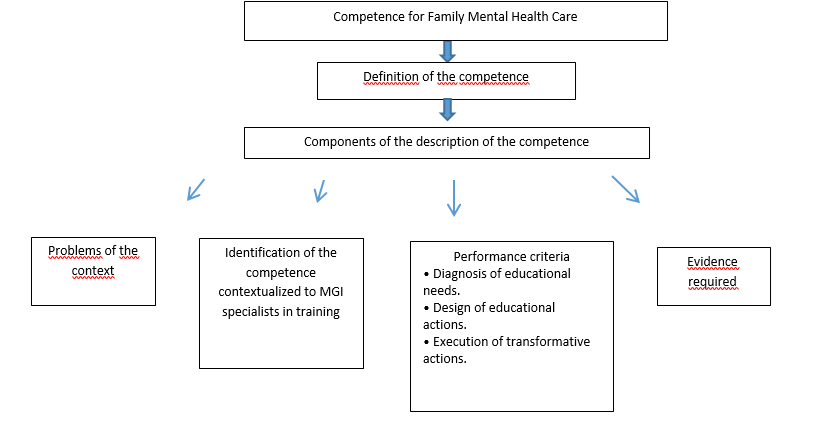
The elements presented allow us to understand the essence of the family mental health care competence to be developed in the MGI specialist in training, which contributes to better performance in the family education they must carry out in the community they serve to mitigate the difficulties that may arise in the mental health of family members. This has an impact on improving dialogue capacity, psychological functioning, and emotional, social, and spiritual well-being. By focusing on strengths to enhance personological and cognitive resources, as well as coping capacity in the face of problems. Hence the value of the results obtained by the authors in the research process with the proposal and application of the competence for mental health care through family education that specialists in training must develop. Despite the enormous efforts made, limitations still persist due to the sample size. However, considered as such from the methodological design, the results respond to the scope defined for the research. Therefore, it is proposed for future research to expand the sample as well as apply it in other academic scenarios.
Conclusions
All that has been expressed allows us to conclude that the description of the conceptual structure of the family mental health care competence is offered as a contribution; it includes the following elements: contextual problems, identification of the competence, and performance criteria, which constitutes invaluable help for Comprehensive General Medicine specialists in training.
The family mental health care competence is of transcendental importance, since it allows physicians to be equipped with tools for family education, which makes it possible to perfect coping mechanisms and the search for collective solutions that improve family functioning.
References
- Aguiar, G., Demothenes, Y., & Campos, I. (2020). La participación familiar en la inclusión socioeducativa de los educandos con necesidades educativas especiales. Mendive, 18(1), 120-133. http://scielo.sld.cu/scielo.php?script=sci_arttext&pid=S1815-76962020000100120&lng=es&nrm=iso&tlng=es
- Becerra Velásquez, A. D. (2025). Familia, bienestar y educación: un pilar para la salud mental en la primera infancia. Tesis de pregrado, Universidad Católica Luis Amigó. Repositorio institucional. https://repository.ucatolicaluisamigo.edu.co/items/5a5b67e0-23c6-4f9e-a1af-bed63e949e9e
- Bellón, J. A., Conejo-Cevin, S., Rodríguez Bajun, A., Ballesta-Rodríguez, M. A., Mendive, J. M., & Moreno Peral, P. (2020). Enfermedades mentales comunes en atención primaria: dificultades diagnósticas y terapéuticas, y nuevos retos en predicción y prevención. Informe SESPAS. Gaceta Sanitaria, 34(51), 20-26. http://doi.org/10.1016/gaceta.2020.05.013
- Benalcazar Duran, C. P., Mosquera Núñez, S. P., Cabanelles Rincón, M. A., & Beleño Penatoza, A. A. (2023). Medicina familiar y Salud Mental. Un abordaje integral de las enfermedades psiquiátricas en el ámbito familiar. Revista Científica de Investigación, 7(3), 76-87. https://reciamuc.com/index.php/RECIAMUC/article/view/1206
- Camas Baena, V., & Herrera Alomoto, G. (2025). Estilos de educación emocional y salud mental en la familia, Manta 2024: Análisis cualitativo. Revista Latinoamericana de Ciencias Sociales y Humanidades, 6(2), 3127-3138. https://doi.org/10.56712/latam.v6i2.3892
- González Sábado, R., & Martínez Cárdenas, A. (2020). Competencia y desempeño del médico de la familia en la prevención de la conducta suicida a nivel comunitario. Multimed, 24(5), 1-10. https://scielo.sld.cu/scielo.php?script=SCI_arttext&pid=S1028-48182020000501033
- Guale Alcivar, L. F., Solís Jiménez, E. A., Rodríguez Marín, V. P., Anchala Caiza, R. E., & Tamayo León, J. A. (2024). Relación entre el funcionamiento familiar y niveles de depresión en estudiantes de la ciudad de Guayaquil. Ciencia Latina Revista Científica Multidisciplinar, 8(5), e1463. https://doi.org/10.37811/cl-rcm.v8i5.14613
- Guden, E., Borlu, A., Alguner, O., Ozsoy, S., & Baykan, Z. (2025). Autoeficacia de los médicos de salud mental: un estudio transversal en Turquía. https://doi.org/10.1111/jep.70097
- Leiva Peña, V., Rubio González, P., & Vicente-Prada, B. (2021). Determinantes Sociales de la Salud mental, políticas públicas desde el modelo biopsicosocial en países latinoamericanos. Revista Panamericana de Salud Pública, 45, e158. https://doi.org/10.266331/RPSP.2021.158
- Machado Ramírez, E. F., & Montes de Oca Recio, N. (2020). Competencias, currículo y aprendizaje en la universidad. Motivos para un debate: Antecedentes y discusiones conceptuales. Revista Transformación, 16(1), 1-2. https://scielo.sld.cu/scielo.php?script=sci_arttext&pid=S2077-29552020000100001
- Machado Ramírez, E. F., & Montes de Oca Recio, N. (2021). La formación por competencias y los vacíos del diseño curricular. Revista Transformación, 17(2), 459-478. https://scielo.sld.cu/scielo.php?pid=S2077-29552021000200459&script=sci_arttext&tlng=pt
- Machado, M., Hernández, M. J., Sampayo, I. C., Gómez, I., Castañeda, R., & Luis, M. E. (2023). Superación del médico general para la atención integral a niños con necesidades educativas especiales. Revista EDUMECENTRO, 15(1), e2390. https://revedumecentro.sld.cu/index.php/edumc/article/view/e2390
- Machado, M., Sampayo, I. C., Hernández, M. J., & Luis, M. E. (2022). Orientación a las familias de niños hiperactivos para potenciar su desarrollo individual. Humanidades Médicas, 22(2), 301-310. https://humanidadesmedicas.sld.cu/index.php/hm/article/view/2313
- Márquez Lisazo, R., Montes de Oca Recio, N., Montejo Lorenzo, M. N., & Carvajal Hernández, B. M. (2023). Los ejes de desempeño científico-profesionales de los estudiantes de educación superior. Transformación, 19(3), 493-504. https://scielo.sld.cu/scielo.php?pid=S2077-29552023000300651&script=sci_arttext
- Mebarak, M., De Castro, A., Salamanca, M., & Quintero, P. (2020). Salud Mental, un abordaje desde la perspectiva actual de la Psicología de la Salud. Psicología del Caribe, (23), 83-112. https://www.redalyc.org/comocitar.oa?id=21311917006
- Méndez, J. S., & Pérez, J. A. (2024). Salud mental presupuesto y política nacional. Centro de Investigación económico y presupuestario, A.C (CIEF). https://ciep.mx/wp-content/uploads/2024/10/Salud-mental.-Presupuesto-y-politica-nacional.pdf
- Miranda Hiriart, G. (2018). De qué hablamos cuando hablamos de Salud Mental. Utopía y praxis latinoamericana, 23(83), 86-95. https://www.redalyc.org/journal/279/27957772009/27957772009.pdf
- Organización Mundial de la Salud [OMS] (2023). Informe mundial sobre Salud Mental. Transformar la salud mental para todos. Versión oficial de la obra en inglés. ISBN 978-92-4-004-933-8, versión impresa ISBN 978-92-75-12771-1
- Padilla Hidalgo, Y., & López Mejías. (2021). Formación de la competencia solución de conflictos escolares en estudiantes de la carrera Licenciatura en Educación Primaria. Revista Transformación, 17(2), 245-256. https://scielo.sld.cu/pdf/trf/v17n2/2077-2955-trf-17-02-326.pdf
- Ramos Hernández, R., Díaz Díaz, A. A., Valcárcel Izquierdo, N., & Ramírez Hernández, B. M. (2018). Las competencias profesionales específicas en la formación de los especialistas en Medicina General Integral. Educación Médica Superior, 32(1), 130-140. https://scielo.sld.cu/scielo.php?script=sci_arttext&pid=S086421412018000100013&lng=es
- Rosas-Santiago, J., Rodríguez-Méndez, Y., Tello-Bello, M. A. J., & López-Suárez, A. D. (2024). Ambiente familiar, calidad de vida y salud mental de adultos Jalapeños. Universita Ciencia, 12(55), 62-77. https://doi.org/10.5281/zenodo.14231627
- Sánchez Arnas, A. M. (2024). Salud mental y atención primaria estrategias para enfrentar la crisis de salud mental global. Revista Sanitaria de investigación, 5(9), 294. https://enfispo.es/servlet/articulo?codigo=9920149
- Saura Llamas, J. (2024). Competencias prioritarias del médico de familia para la práctica clínica: primera parte. Archivos en Medicina Familiar, 26(1), 59-69. https://www.medigraphic.com/cgi-bin/new/resumen.cgi?IDARTICULO=114501
- Sotomayor Casalis, D. R., & Águila Carralero, A. (2021). Estrategia pedagógica para formar la competencia resolución de conflictos en estudiantes de Sociología. Rev. Mendive, 19(1), 67-85. https://scielo.sld.cu/scielo.php?pid=S1815-76962021000100067&script=sci_arttext
- Sotomayor Casalís, D. R., & Águila Carralero, A. (2023). Competencia resolución de conflictos: pautas teórico-metodológicas para su formación en estudiantes de Sociología. Rev. Mendive, 20(1), 59-82. https://scielo.sld.cu/scielo.php?pid=S18-15-76962022000100069&script=sci_arttext
- Tobón, S. (2017). Evaluación socio-formativa. Estrategias e instrumentos. Kresearch.
- Zapata-Martínez, A., Rodríguez-Vargas, M. A., Salgado Valencia, M. L., & Naranjo-Londoño, C. M. (2024). Salud mental en jóvenes universitarios: reflexiones sobre familia, cuerpo y emociones. Revista Latinoamericana de Ciencias Sociales, niñez y juventud, 22(3), 255-282. https://doi.org/10.11600/ricsnj.22.3.6640
Conflict of interests:
The authors declare no conflicts of interests.
Curricular synthesis:
Elenia Luisa Díaz Hernández is a Master in Social Work, Psychologist, and professor at the Arturo Puig Ruiz de Villa Polyclinic, with more than ten years researching topics related to mental health, tutoring and advising theses.
Estrella García Quintero is a Doctor of Pedagogical Sciences, Full Professor at the University of Camagüey, with more than 15 years tutoring theses and researching topics related to family education.
Oscar Loyola Hernández is a Doctor of Sciences, Professor and Full Researcher at the University of Camagüey, with more than 15 years serving as tutor and advisor of theses on dissimilar topics.
Declaration of authorship responsibility:
The authors participated in the search and analysis of information for the article, as well as in its design and writing.
Elenia Luisa Díaz Hernández: was in charge of the search for information and assumed the description of the mental health care competence in Comprehensive General Medicine specialists in training.
Estrella García Quintero: was in charge of the methodological direction of the research, participated in the processing of theoretical information and the systematization of theoretical-methodological references.
Oscar Loyola Hernández: participated in information management, contributed to the argumentation of the competence.
Edited by: Sc. D. Manuel N. Montejo Lorenzo, translated by B.A. Yailén Fernández Daniel.
This is an Open Access article distributed according to the terms of the Creative Commons License:
https://creativecommons.org/licenses/by-nc/4.0/deed.es_ES
which allows non-commercial use, distribution, and reproduction without restrictions in any medium, provided the primary source of publication is duly cited.