Formación profesional y orientación profesional: La clave para la retención estudiantil durante el primer año de los programas universitarios
Vocational Training and Career Guidance: The Essence of Student Retention During the First Year of University Programs
2 Internacional Levante España
Introducción: En los años recientes se ha reportado un incremento sostenido del número de estudiantes que causan baja de la Educación Superior en Ecuador. Esto sugiere que se trata de un tema prioritario para las ciencias pedagógicas.
Objetivo: Compartir un enfoque pedagógico para mejorar la retención en la Educación Superior, basado en la formación vocacional y la orientación profesional, como contribución a la reducción de las tasas de deserción durante el primer año de estudios.
Métodos: Se aplicó una metodología de revisión documental de sistematización de la información relevante sobre formación profesional y orientación vocacional en la experiencia latinoamericana y en el contexto del sistema educativo ecuatoriano. Igualmente, una modelación teórica desde un enfoque cualitativo y alcance descriptivo que facilitó la articulación del proceso de acceso a la Educación Superior entre las universidades y la educación previa de los estudiantes.
Resultado: Se identifican diferencias epistemológicas y conceptuales respecto a la formación profesional y la orientación vocacional; falta de experiencias sobre la necesaria vinculación estratégica entre las instituciones de Educación Secundaria y Superior; limitado tratamiento teórico, metodológico y práctico que la formación profesional, la orientación vocacional y la motivación profesional; bajas tasas de retención durante el primer año de los programas universitarios en el Ecuador; una modelación teórica para el desarrollo de la motivación profesional basada en un proceso continuo y constante de la formación vocacional y la orientación profesional.
Conclusiones: El estudio logró su objetivo de compartir un enfoque pedagógico orientado a mejorar la retención estudiantil en la Educación Superior durante el primer año de los programas de grado, basado en la formación vocacional y la orientación profesional. La metodología aplicada demostró ser efectiva para comprender la complejidad del abandono universitario y para construir un modelo conceptual sólido, relevante y aplicable al contexto ecuatoriano.
Introduction: In Ecuador, in recent years, there has been a steady increase in the number of students entering Higher Education. At the same time, there has also been a significant decrease in university dropout rates, with trends for 2025 predicting an increase of up to 25% during the first year of studies, which constitutes a national issue and a priority for Pedagogical Sciences.
Objective: This paper aims to describe a pedagogical approach for improving retention in Higher Education, based on vocational training and professional guidance, as a contribution to reducing dropout rates during the first year of studies.
Methods: A documentary review methodology and theoretical modeling were applied to support this pedagogical approach implemented within the Educational Model of Universidad International SEK (2025), which facilitates that the process of access to Higher Education demonstrates that the articulation between universities and prior education can be realized through vocational training and professional guidance of future students, thereby ensuring that they have a better understanding of the profession, an essential foundation for developing their professional motivation and, consequently, for achieving university retention.
Results: Professional education and vocational guidance conceptual differences is clearly argued. The study shows the need of a strategical relation between senior high school and university institutions, points out theoretical limitations and Ecuadorian freshmen retention rates. Likewise, a model for arising motivation is devised.
Conclusions: The study accomplishes the objective of describing a pedagogic approach for improving retention rates in Higher Education. The suggested methods prove to be effective, they are reliable and relevant and feasible for the Ecuadorian context.
Introduction
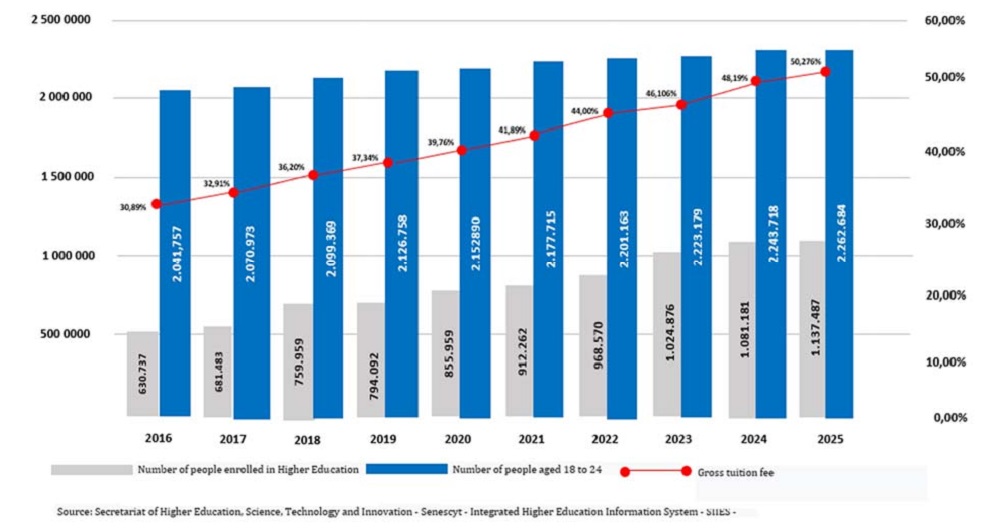
One of the fundamental priorities of Ecuadorian Higher Education is reflected in the contradiction that occurs between the sustained growth of the gross enrollment rate expressed as a percentage in relation to the population aged 18 to 24 (see figure 1) and the high dropout rates that are reached during the first year of university programs. According to a report 2022 (Senescyt, 2022), within the framework of the National Development Plan —Plan for Creating Opportunities (2021-2025)— issued by the National Planning Secretariat (2021), foresees that by the year 2025, the dropout rate for this stage of university studies will reach 19.89%, calculated using a cumulative national annual variation rate between 2015 and 2021. This shows that, although there is a trend of increasing enrollment of new students, it is countered by a considerable decline in university retention.
The Higher Education System Development Plan (Consejo de Educación Superior, 2022) for the 2022–2026 period is based on a national diagnostic study derived from the challenges facing the Ecuadorian Higher Education system. It acknowledges that high dropout rates are closely linked to behavioral problems, academic performance, and students' lack of interest in pursuing university studies. This reality supports the need to create a pedagogical framework that promotes better attention to students' interests, goals, plans, and life projects.
The Ecuadorian reality is complex in relation to university retention, especially in the first year. Predictions presented in a Diagnostic Report on Higher Education and Science post COVID-19 (Organization of Ibero-American States, 2022) foresees a regional increase in Latin America of dropout rates between 10% and 25%, considering all years of study and citing reasons based on the effects of the economic crisis, which has been exacerbated by the post-pandemic situation and the digital divide present in most countries of the region.
Figure 1. Gross enrollment ratio in tertiary higher education, first-year projection to 2025 (%)
The authors, aware of the situation described above, consider that studies should also take into account reasons related to the personal development of students entering universities, which, according to Castro et al. (2016), Gallego et al. (2019), and Barattini (2020), are reflected in university dropout rates, whose origin is professional motivation, which develops from previous education and must continue developing during the first year of the degree programs. Various Ecuadorian studies and international publications related to university retention, among which those by Herreño et al. (2024); Ayala et al. (2023); Galve et al. (2022); Barrios et al. (2021); Bravo et al. (2020); Arias et al. (2018); Bernardo (2018); Vergara et al. (2016); Pesántez et al. (2015) stand out, agree that, despite the influence of the existing socioeconomic reality, gaps and deficiencies can be identified epistemological, methodological, and practical aspects in the educational models of secondary and university institutions that do not promote the achievement of a conscious retention of newly admitted students in the selected programs.
The studies by Barrios et al. (2018) justify that university retention is a process that takes place throughout the entire curriculum, but it's essential and decisive stage can be focused during the first year of the programs, which is where the highest number of dropouts occurs. Consequently, it is necessary to identify the genesis of these negative manifestations, both for the students and for society as a whole, taking into account the levels developed by students in relation to professional motivation.
The studies reviewed at CLABES Congresses by Barría et al. (2021), Olvera and Cruz (2021), Hurtado and Prieto (2021), Stepke et al. (2020), Zumárraga et al. (2020) provide essential elements for vocational guidance. From a theoretical point of view, it is assumed, as proposed by González (1982), that the main personal resource that ensures that the students right choice is professional motivation, which constitutes the core of the career guidance received during prior education. In the same way, according to Sampedro et al. (2006), career guidance is the result, over time and from an early age, of vocational training also developed by the individual. Reality shows that both career guidance and vocational training currently have limited influence and prominence at university institutions in their relationship with preceding educational institutions and vice versa.
In line with the above, works such as those by Ponce and Carrasco (2017) and Mena et al. (2021), among others, are based on the pedagogical concept that characterizes the dialectical articulation of Secondary Education and universities, which in Ecuador shows a limited connection between these educational levels. This generally results in the development of vocational training that is disconnected from contextual needs and offers generic rather than specialized professional guidance, compounded by constant changes in educational regulations.
According to Valle Lima (2007), in Pedagogical Sciences, a conception is a scientific outcome in which a system of ideas, concepts, and representations about an aspect of educational reality is modeled, in the search for a foundation for practical activity. This is closely related to Kuhn (1962), an author who reflects on theoretical conceptions as part of a higher system of thought that guides research and the interpretation of data associated with it.
Taking all of the above into account, the scientific problem to be addressed was determined: how to contribute to reducing university dropout during the first year of study programs?
The objective, as the purpose and goal of this work, highlights the authors' aspiration to "Socialize a pedagogical approach for improving retention in Higher Education, based on vocational training and professional guidance, as a contribution to reducing dropout during the first year of degree programs".
Methods
The research is approached from a descriptive scope and a qualitative approach, according to Hernández Sampieri et al. (2014). From this scientific perspective, the following methodological actions are highlighted:
1. Systematic documentary review based on the procedure proposed by Peters et al. (2015). A systematization of relevant information regarding vocational training is carried out and Career guidance in the Latin American experience and in the conditions of the Ecuadorian education system. For this, the following is taken into account:
1.1 The Scopus database was selected, using the following inclusion criteria: a) Ecuadorian scientific articles from 2019 to 2023, related to vocational training; professional guidance, and professional motivation, connected to any of the initial, basic, and high school levels. b) Ecuadorian scientific articles from 2019 to 2023, related to vocational training; professional guidance, and professional motivation. c) Ecuadorian scientific articles from 2019 to 2023, related to experiences linking Secondary Education and Higher Education, and including vocational training; professional guidance, and professional motivation.
1.2. Use of the database hosted on the Red Guía Gestión Universitaria Integral del Abandono CLABES from 2019 to 2021 (hosted at the University of Technology of Panama Journal Portal). Articles were selected using the following inclusion criteria: works related to vocational training; career guidance and professional motivation in Secondary Education from the first year to the third year of high school, and linked to Higher Education.
1.3. Information on references and the specification of the modeling was requested through an interaction with ChatGPT, an artificial intelligence developed by OpenAI (2025).
2. Theoretical modeling based on the systemic–structural–functional research method, which is aimed at modeling the object through the determination of its components and the relationships between them, thus forming a new quality of the object itself. These relationships determine the structure and hierarchy of each component within the object and its dynamics, its functioning. The systemic–structural–functional method becomes, in addressing the problem of the present study, an important means to describe the genesis of the university retention process and its improvement characteristics during the first year of the degree programs (Álvarez de Zayas, 2017).
Results and discussion
A total of seven articles were identified in the Scopus database, whose main patterns were related to: evident epistemological and conceptual differences regarding vocational training and career guidance. Likewise, a lack of experiences concerning the necessary strategic linkage between Secondary Education and Higher Education institutions was observed.
In the thematic line connecting Secondary and Higher Education, reviewed within the Guía Gestión Universitaria Integral del Abandono CLABES network, in its Congress versions from 2019 to 2021, the limited theoretical, methodological, and practical treatment that vocational training, career guidance, and professional motivation have received in and from Secondary and Higher Education in a coordinated manner was confirmed.
The absence of publications on joint strategies between universities and education related to the integrated study subjects of vocational training, career guidance, and professional motivation to increase university retention rates in Ecuador can be attributed, among other factors, to the low priority given to interinstitutional collaboration. According to Gómez & Pérez (2018), educational policies in many countries do not sufficiently encourage research in this area, which limits scientific production. Likewise, the lack of longitudinal data and the limited integration of educational systems complicate the evaluation of effective strategies (López, 2017). These obstacles limit the visibility of such studies in high-impact databases like Scopus.
Consequently, it is possible to delve into the Ecuadorian reality, which differs politically, socially, economically, and educationally from other contexts, and address the issues presented in this work with pedagogical approaches aimed at solving manifestations of low retention rates during the first year of university programs when they are linked to causes related to low levels of professional motivation.
Modeling results
The object of study, the process of persistence in Higher Education from vocational training and professional guidance, is modeled using the systemic–structural–functional research method (see figure 2).
Figure 2. Graphical representation of the modeling of the pedagogical conception of the retention process through vocational training and career guidance as a contribution to reducing university dropout during the first year of the degree.
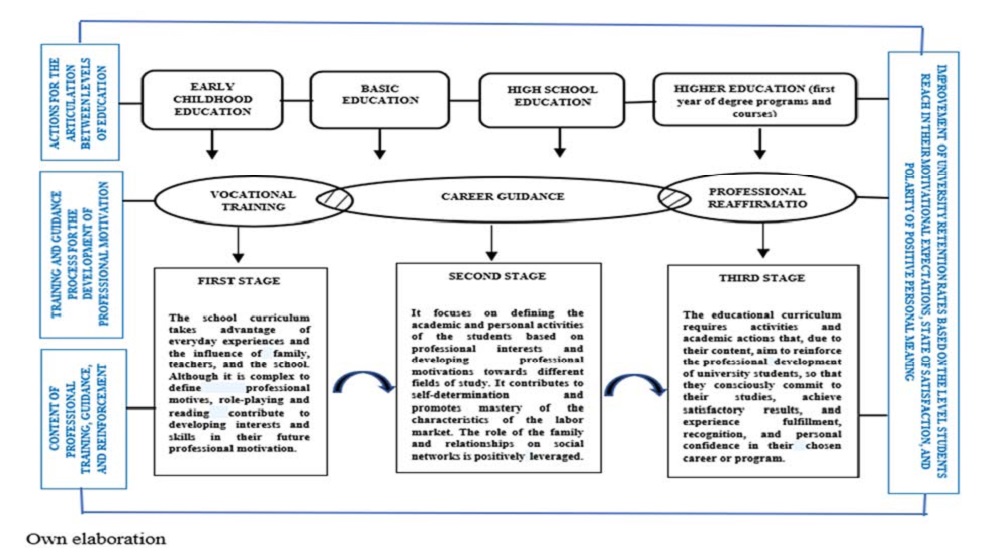
The modeling carried out using the systemic–structural–functional research method is described below:
Components of the genesis of the university retention process up to the first year of the degree:
- a) Vocational training.
- b) Career guidance.
- c) Professional reaffirmation.
These components are developed with different objectives and contents, systematically, coherently, and they maintain close dialectical relationships among themselves. Students progressively develop their personality and professional inclinations based on learning experiences, combined with social influences. Systematizing professional guidance stands, as both a process and a quality, in the mediation of the construction of meanings and feelings about professions. This equips them with the necessary knowledge so that, when the time comes, they can consciously choose and affirm the profession they wish to study, with full conviction and professional identity according to the needs of society and their personal interests.
Relationships of the components: According to Bertalanffy's General Systems Theory (1968), the model presents key criteria for pedagogical conception, taking into account that its synergy promotes collaboration and amplifies coordinated actions in the educational environment. Entropy helps management processes avoid disorder and promote organized and efficient structures. Homeostasis ensures stability, allowing adaptations to changes. Autopoiesis highlights the continuous self-renewal of actions, resulting in the development of professional motivation, fostering autonomy and the capacity of institutions to self-organize. These relationships integrate a pedagogy that gives meaning and purpose to the structure of the model and, consequently, determine one of its essential functions: those new students, by reaffirming their choice of degree, remain in their studies.
New quality derived from the relationships between components: The development of professional motivation, as conceived in the pedagogical framework, impacts university retention outcomes and can be expressed through students' goals, plans, and life projects, in a future-oriented manner as a preparation for their professional practice. It constitutes the expression of the emotional experience regarding motivational fulfillment, through which academic performance is regulated, involving personal resources such as time perspective, perseverance, flexibility, personalized reflection, and the active stance taken to achieve professional interests.
Practical application of result
The pedagogical approach for improving retention in Higher Education has been one of the essential foundations of the 2024 Educational Model (Gallar & Barrios, 2024) implemented at the International SEK University (UISEK) as a contribution to improving university retention rates. During the first year of the programs, it is implemented through:
The system of planned and developed actions from the Admissions and Marketing Department is carried out jointly with all the programs that make up the educational offer and with the set of schools and colleges in the context of the Metropolitan District of Quito (the fundamental basis of the institution's on-campus enrollment). These inter-institutional collaboration actions, from their pedagogical content, are aimed at training, advising, and supporting the needs of administrators, teaching staff, and families, with the purpose of improving the vocational training process and professional guidance. Similarly, it serves as feedback to the programs to strengthen actions in achieving the professional reaffirmation of new students.
The pedagogical strategy that the programs design and implement for new entrants is derived, among other aspects, from the results of the professional motivation assessment, which allows for specifying actions within each of the four institutional differentiators with a view to professional reaffirmation:
- a) Differentiator: Personalization of training contributes to ensuring that syllabus planning aligns with the strengths, needs, skills, and interests identified in each student, considering their psychocognitive, personal, motivational, and emotional development.
- b) Differentiator: Internationalization of the educational offering prioritizes those new students actively participate in productive and service environments within local, national, regional, and global contexts. This helps them approach their chosen profession with greater intentionality, understanding its characteristics, employability prospects, and opportunities for personal growth.
- c) Differentiator of the training in comprehensive hard and soft skills, it is expected that the integration of teaching, research, and community engagement functions will achieve a balance between knowledge, know-how, personal development, and social skills as a foundation for personal formation, and not just the technical skills required by the profession.
- d) Differentiator of Educational Technological Innovation, it is ensured that its use (as a learning resource and professional tool) enhances a motivational state that is crucial for student protagonist role. In this, the ethical and responsible use of artificial intelligence and its associated technologies plays an essential role. These technologies have been shown to adapt to individual needs, fostering student participation and engagement through tools that enable interactive exploration, helping to create a more inclusive and effective environment and increasing students' confidence, including: the use of specialized software with virtual reality, web and mobile applications, online interactive workshops, and advanced tools with artificial intelligence.
A comparative study between the retention results recorded at the Academic Registry Directorate of UISEK for the academic periods from 2021 to 2023, compared with the first-year dropout rate of tertiary-level undergraduate students in Ecuador between 2015 and 2021 (Senescyt, 2022), allows us to confirm the contribution of the application of the pedagogical approach to improving retention at UISEK (see figure 3).
Figure 3. Graphical representation comparing the annual variation of university dropout rates between national data from Ecuador and that recorded at the International SEK University from 2021 to 2023

Conclusions
The study fully achieved its objective of disseminating a pedagogical approach aimed at improving student retention in higher education during the first year of degree programs, based on vocational training and professional guidance. The methodology applied —which combined a systematic literature review and theoretical modeling through the systemic-structural-functional method— proved to be effective for understanding the complexity of university dropout and for constructing a sound, relevant, and applicable conceptual model for the Ecuadorian context.
The document review made it possible to identify epistemological gaps and limitations in the articulation between Secondary Education and Higher Education, which justified the need to design a pedagogical conception that would strengthen this relationship. Meanwhile, the theoretical modeling made it possible to coherently structure the essential components of the retention process and define the dialectical relationships that give rise to a new quality: the development of professional motivation as a regulating axis for academic choice and continuity.
The results achieved show that the proposed pedagogical approach is not only theoretically sound but also applicable within an institutional educational model. Its implementation in practice helped to enhance actions of support, personalization, internationalization, and innovation, generating positive impacts on the professional reaffirmation of new entrants. Consequently, the proposal constitutes a viable and necessary strategy to strengthen university retention from a comprehensive and coordinated perspective.
references
- Álvarez de Zayas, C. M. (2017). Metodología de la Investigación Científica. Quito, Ecuador: Universidad Internacional SEK.
- Arias, M., Bastidas, M., & Salazar, C. (2018). Estudio sobre la deserción estudiantil universitaria y sus implicaciones académicas, económicas y sociales. Boletín De Coyuntura, 19, 9–13. https://doi.org/10.31243/bcoyu.19.2018.677
- Ayala-Carabajo, R., & Llerena-Izquierdo, J. (2023). Modelo preventivo para minimizar estudiantes en riesgo académico para las asignaturas del primer año universitario. Congreso de Docencia en Educación Superior CODES, 5, (p. 1-12). La Serena. https://doi.org/10.15443/codes1917
- Barría, G., Salazar, D., & Theza, D. (2021). La orientación vocacional en formato virtual: desafíos y proyecciones. Congresos de Latinoamérica sobre abandono en la Educación Superior (p. 1-7). Universidad Tecnológica de Panamá. https://revistas.utp.ac.pa/index.php/clabes/article/view/3377
- Barrios, E., Gómez García, A., Pazmiño Vergara, A., Gallar, Y., & Chávez Rivera, M. (2018). Sistema de gestión integral para el acceso, la permanencia, el egreso y la empleabilidad universitaria. Congresos de Latinoamérica sobre abandono en la Educación Superior (p. 1-11). Universidad Tecnológica de Panamá. https://revistas.utp.ac.pa/index.php/clabes/article/view/2032
- Barrios Queipo, E., Gallar Pérez, Y., Rodríguez Jiménez, N., & Villacís Bermeo, K. (2021). Experiencia educativa sobre el incremento del acceso y la reducción del abandono estudiantil en la Universidad Internacional SEK Ecuador (2016-2021). Congresos de Latinoamérica sobre abandono en la Educación Superior (p. 1-8). Universidad Tecnológica de Panamá. https://revistas.utp.ac.pa/index.php/clabes/article/view/3439
- Barattini, A. (2020). Programa de formación en docencia para el primer año de la Educación Superior en la universidad de Chile: favoreciendo la permanencia. Congresos de Latinoamérica sobre abandono en la Educación Superior (p. 1-8). Universidad Tecnológica de Panamá. https://revistas.utp.ac.pa/index.php/clabes/article/view/2743
- Bernardo, A. B., Cervero, A., Esteban, M., Fernández-González, A., Solano, P., & Agulló, E. (2018). Variables relacionadas con la intención de abandono universitario en el periodo de transición. Revista d'Innovació Docent Universitària, 10, 122-130. http://doi.org/10.1344/RIDU2018.10.11
- Bertalanffy, L. V. (1968). General System Theory: Foundations, Development, Applications. George Braziller.
- Bravo, F. E., Peña, M. P., & Illescas, L. E. (2020). Reprobación y abandono de estudiantes universitario. Uniandes Episteme, 7(4), 502–516. https://revista.uniandes.edu.ec/ojs/index.php/EPISTEME/article/view/1728
- Castro, F., Durán, E., & Urbieta, E. (2016). Talleres de Orientación Educativa: Estrategia de Apoyo para la adecuada elección de carrera. Congresos de Latinoamérica sobre abandono en la Educación Superior (p. 1-7). Universidad Tecnológica de Panamá. https://revistas.utp.ac.pa/index.php/clabes/article/view/1310
- Consejo de Educación Superior. (2022). Plan de desarrollo superior 2022-2026. https://www.ces.gob.ec/wp-content/uploads/2022/10/plan_de_desarrollo_ses_2022-20260068811001663958711.pdf
- Galve, C., Blanco, E., Vázquez Merino, D., Herrero, F.J., & Bernardo, A.B. (2022). Influencia de la satisfacción, expectativas y percepción del rendimiento en el abandono universitario durante la pandemia. Revista de Estudios e Investigación en Psicología y Educación, 9(2), 226–244. https://doi.org/10.17979/reipe.2022.9.2.9153
- Gallar, Y. & Barrios, A. (2024). Modelo Educativo UISEK. Universidad Internacional SEK. https://uisek.edu.ec/la-universidad/nosotros/reglamentos/
- Gallego, L., Castrillón Hoyos, W., & Marín Vásquez, J. (2019). Factores que intervienen en la intencionalidad de deserción estudiantil en el programa de zootecnia de la Universidad De Antioquia, sede Medellín. Congresos de Latinoamérica sobre abandono en la Educación Superior (p. 1-8). Universidad Tecnológica de Panamá. https://revistas.utp.ac.pa/index.php/clabes/article/view/1675
- Gómez, A., & Pérez, L. (2018). Políticas educativas y la falta de incentivos para la investigación en estrategias conjuntas entre universidades y educación precedente. Editorial Académica.
- González Rey, F. (1982). Motivación profesional en adolescentes y jóvenes. Editorial Pueblo y Educación. La Habana.
- Hernández Sampieri, R., Fernández Collado, C., & Baptista Lucio, M. del P. (2014). Metodología de la investigación (6. ed.). McGraw Hill Interamericana.
- Hurtado, A., & Prieto, L. (2021). Cuestionario de intereses profesionales de la Universidad de La Sabana (C.I.P.U.S.). Congresos de Latinoamérica sobre abandono en la Educación Superior (p. 1-8). Universidad Tecnológica de Panamá. https://revistas.utp.ac.pa/index.php/clabes/article/view/3372
- López, R. (2017). La inclusión educativa: Una tarea que le compete a toda una sociedad. Redalyc. https://www.redalyc.org/pdf/447/44730104.pdf
- Kuhn, T. S. (1962). The structure of scientific revolutions (2nd ed). University of Chicago Press. https://www.lri.fr/~mbl/Stanford/CS477/papers/Kuhn-SSR-2ndEd.pdf
- Mena, M., Godoy, W., & Tisalema, S. (2021). Análisis de causas de la deserción temprana de estudiantes de Educación Superior. Minerva, Multidisciplinary y Journal of Scientific Research, 2(6), 79-89. https://dialnet.unirioja.es/descarga/articulo/8377977.pdf
- Olvera, G., & Cruz, S. (2021). Una experiencia de orientación vocacional en apoyo a la permanencia escolar. Congresos de Latinoamérica sobre abandono en la Educación Superior (p. 1-7). Universidad Tecnológica de Panamá. https://revistas.utp.ac.pa/index.php/clabes/article/view/3376
- OpenAI. (2025). ChatGPT-4 (Versión de marzo 2024) [Modelo de lenguaje amplio]. https://chatgpt.com/c/5257473c-37ed-427b-b911-1e05bc13e716
- Organización de los Estados Iberoamericanos. (2022). Informe diagnóstico sobre la Educación Superior y la ciencia post COVID-19 en Iberoamérica. Perspectivas y desafíos de futuro 2022. https://oei.int/oficinas/secretaria-general/publicaciones/informe-diagnostico-sobre-la-educacion-superior-y-la-ciencia-post-covid-19-en-iberoamerica-perspectivas-y-desafios-de-futuro-2022
- Pesántez, F., Martín, E., & Bojorque, R. (2015). Una mirada crítica al sistema de acceso a la Educación Superior ecuatoriana. Revista Cubana de Educación Superior, 34(2), 63-76. http://scielo.sld.cu/scielo.php?script=sci_arttext&pid=S0257-43142015000200007&lng=es&tlng=es
- Peters, M. D. J., Godfrey, C. M., Khalil, H., McInerney, P., Parker, D., & Soares, C. B. (2015). Guidance for conducting systematic scoping reviews. International Journal of Evidence-Based Healthcare, 13(3), 141-146. https://doi.org/10.1097/XEB.0000000000000061
- Ponce, J., & Carrasco, F. (2017). Acceso y equidad a la Educación Superior y posgrado en el Ecuador, un enfoque descriptivo. Mundos Plurales. Revista Latinoamericana de Políticas y Acción Pública, 3(2), 9–22. https://doi.org/10.17141/mundosplurales.2.2016.2841
- Sampedro, R., Cueto, R. & Barrera, I. (2006). Estrategia para el trabajo de orientación profesional hacia carreras pedagógicas. Revista Mendive, 14(3), 1-12. https://scielo.sld.cu/scielo.php?pid=S1815-76962016000300004&script=sci_arttext
- Secretaría de Educación Superior, Ciencia, Tecnología e Innovación (Senescyt). (2022). Indicadores de Educación Superior, ciencia, tecnología e innovación. https://siau.senescyt.gob.ec/wp-content/uploads/2023/01/Estudio-Indicadores-PND_0123.pdf
- Secretaría Nacional de Planificación. (2021). Plan de Creación de Oportunidades 2021-2025. https://www.planificacion.gob.ec/plan-de-creacion-de-oportunidades-2021-2025/
- Lagos, M., & Bustos, C. (2020). Modelo de trabajo de talleres de desarrollo de competencias socioemocionales y de orientación vocacional con estudiantes secundarios del PACE-UCT 2015-2019 para la disminución del abandono. Congresos de Latinoamérica sobre abandono en la Educación Superior (p. 651-660). Universidad Tecnológica de Panamá. https://revistas.utp.ac.pa/index.php/clabes/article/view/2710
- Valle Lima, A. (2007). Metamodelos de la investigación pedagógica. La Habana, Cuba: Instituto Central de Ciencias Pedagógicas, Ministerio de Educación.
- Vergara, J., Del Valle, M., Cobo, R., Pérez, M., & Díaz, A. (2016). Factores explicativos del abandono académico de estudiantes de pedagogía. Congresos de Latinoamérica sobre abandono en la Educación Superior (p. 651-660). Universidad Tecnológica de Panamá. https://revistas.utp.ac.pa/index.php/clabes/article/view/1345
- Zumárraga, M., Luzuriaga, J., Armas, R., González, Y., & Peñaherrera, L. (2020). ¿Los rasgos de personalidad importan? Medición y análisis de su correlación con el rendimiento académico como aporte a los procesos institucionales de orientación vocacional. Congresos de Latinoamérica sobre abandono en la Educación Superior (p. 265-275). Universidad Tecnológica de Panamá. https://revistas.utp.ac.pa/index.php/clabes/article/view/2699
Síntesis curricular:
Enrique Barrios Queipo: Doctor en Ciencias Pedagógicas y Máster en Investigación Educativa. Profesor Titular e Investigador con amplia trayectoria en la Educación Superior y Profesor Titular Principal II en Ecuador. Es profesor invitado en universidades de España, Chile, Colombia, México. Experto tecnológico-educativo del INCUAL, donde dirigió proyectos de cualificaciones y reconocimiento de aprendizajes. Ha publicado decenas de libros ya artículos.
Gallar Pérez Yamirlis: Directora Pedagógica y de Estudios Generales de la Universidad Internacional SEK-Ecuador. Doctora en Ciencias Pedagógicas, Profesora Titular y Profesora Investigadora. Es Licenciada en Educación Infantil. Acumula más de 30 años de experiencia en la Educación Superior en Ecuador, Chile, Venezuela y Cuba. Ha dirigido múltiples proyectos de investigaciones pedagógicas y didácticas, tesis doctorales, de maestría y de grado. Es autora de modelos educativos de universidades. Posee múltiples publicaciones científicas difundidas en revistas de alto impacto.
José María Delgado Mateo: Doctor en Ciencias. Profesor Titular. Posee una extensa experiencia en gestión en la Institución Internacional SEK, así como en docencia e investigación en la Educación Superior en varios países de Europa y América. Destacan en los últimos años sus resultados en gestión educativa como Vicerrector de la Universidad Internacional SEK en Ecuador; Director del Colegio Internacional Levante España y Director del Centro Universitario Superior de Negocios, Innovación y Tecnología de Madrid.
Declaración de responsabilidad autoral:
Enrique Aurelio Barrios Queipo: Ejerció la dirección metodológica de la investigación. Tuvo a su cargo la búsqueda bibliográfica, la construcción de los fundamentos aportados y la dirección de la implementación en la práctica. Sistematizó los resultados y preparó el manuscrito.
Yamirlis Gallar Pérez: Colaboró en la búsqueda bibliográfica, la construcción de los fundamentos aportados y la dirección de la implementación en la práctica.
José María Delgado: Ejerció la codirección metodológica de la investigación y colaboró en la fundamentación pedagógica.
Editado por: Dr. C. Manuel N. Montejo Lorenzo
Este es un artículo en Acceso Abierto distribuido según los términos de la Licencia Creative Commons:
https://creativecommons.org/licenses/by-nc/4.0/deed.es_ES
que permite el uso, distribución y reproducción no comerciales y sin restricciones en cualquier medio, siempre que sea debidamente citada la fuente primaria de publicación.